There are two kinds of game-day hosts.
The ones worried they won’t have enough food.
And the ones who made enough food to feed the offensive line, marching band, coaching staff, and several neighboring counties.
Most of us have been both.
Figuring out how much food to make for a football party gets especially tricky because game day isn’t quite dinner and it isn’t quite a regular party. People graze. They go back for seconds. They eat during commercial breaks. Someone who claimed they “weren’t that hungry” will somehow make four trips through the food.
And if teenagers are involved, all calculations become theoretical.
So instead of guessing, here’s a practical way to figure out how much game-day food you actually need.
First: What Kind of Game Day Are You Hosting?
Before calculating wings or counting sliders, figure out what you’re actually serving.
There’s a huge difference between:
“Come over and watch the game. We’ll have snacks.”
and
“Come over at 5:00. I’m feeding everybody dinner.”
If your party overlaps a normal mealtime, people are going to treat your food like a meal whether you intended them to or not.
For a snack-only gathering, you can plan smaller quantities and more variety.
For a game-day meal, make sure there’s at least one substantial main dish along with your appetizers and sides.
And if people will be there for several hours?
Plan for grazing.
Because they will.
The Game-Day Crowd Cheat Sheet
In Feed the Team, I divide game-day crowds into four groups because “a crowd” can mean six people in one house or thirty people standing around folding tables.
SMALL SQUAD
4–6 people
Keep it simple.
You don’t need six appetizers and three mains for five people unless your actual goal is leftovers.
A good spread might include:
1 main + 1–2 appetizers + 1–2 sides + 1 dessert + drinks
STARTING LINEUP
8–12 people
This is where my standard game-day formula works beautifully:
1 main + 2 pregame picks + 2 sidelines + 1 fourth-quarter treat + drinks
Choose recipes that make enough for seconds without creating ridiculous amounts of leftovers.
FULL ROSTER
15–20 people
Now we’re officially feeding a crowd.
Keep the same basic structure, but increase quantities rather than automatically adding more dishes.
That’s important.
More people don’t always require more recipes. They require more food.
Two big pans of sliders are usually easier than making four completely different mains.
PACKED STADIUM
25+ people
This is where big-batch food earns its scholarship.
Think:
- chili
- gumbo
- jambalaya
- taco bars
- walking tacos
- pulled pork
- sliders
- hot dogs and brats
- nacho bars
- slow-cooker dishes
- large pans of sides
Self-serve is your friend.
So are disposable pans.
And labels.
And accepting that somebody is going to put the wrong spoon back in the wrong bowl.
How Much Food Per Person Should You Make?
These are starting estimates, not federal law.
Adjust them based on whether you’re serving a full meal, how many other dishes you have, how long everyone is staying, and who you’re feeding.
Appetizers
If appetizers are being served before a full meal, plan roughly:
4–6 appetizer portions/bites per person
If appetizers are the meal, increase that to roughly:
10–12 bites per person, especially for a longer game.
The more different appetizers you offer, the less you need of each individual one.
For dips, roughly ¼ cup per person per dip is a useful starting point when several other foods are available.
And buy more chips than you think you need.
Seriously.
The dip-to-chip ratio has ruined many otherwise respectable parties.
Sliders
If sliders are your main dish, plan approximately:
2–3 sliders per adult
For children, 1–2 may be plenty.
If sliders are just one option among several substantial foods, you can usually plan closer to 1–2 per person.
For 10 adults with sliders as the primary main, for example, I’d want around 24–30 sliders rather than making exactly 20 and hoping nobody gets ambitious.
Chicken Wings
Wings are where the rest of your menu really matters.
If they’re part of a larger spread, plan approximately:
4–6 wing pieces per person
If wings are the primary attraction:
8–12 pieces per person is a safer range.
For a group that takes wings very seriously, err toward the higher end.
You know your people.
Hot Dogs, Brats & Sausages
When they’re the primary main, plan:
1–2 per person
For adults, I’d lean toward 2 available per person, particularly when you’re serving brats or smaller sausages.
Kids may eat one.
Teenage boys may invalidate the entire spreadsheet.
Tacos & Walking Tacos
For regular tacos, plan around:
2–3 tacos per person
If you’re using smaller tortillas or feeding a particularly hungry crowd, go higher.
For taco meat, approximately ¼ pound of cooked filling per adult is a reasonable starting point when toppings and sides are also available.
The beauty of a taco bar is that inexpensive toppings help stretch the meal:
- lettuce
- cheese
- tomatoes
- salsa
- sour cream
- beans
- corn
- onions
- jalapeños
- chips
People build exactly what they want, and you aren’t individually assembling 37 tacos while missing the game.
Chili, Gumbo, Jambalaya & Other Big-Pot Meals
For a hearty soup, chili, gumbo, or similar main, plan approximately:
1½–2 cups per adult
You can stretch those servings considerably with the right accompaniments.
Chili gets cornbread, crackers, cheese, sour cream, chips, or baked potatoes.
Gumbo gets rice.
Red beans get rice.
And pretty much anything Southern can be stretched by somebody’s grandmother insisting everyone needs another piece of bread.
Side Dishes
When you’re serving several sides, approximately:
½ cup of each side per person
is generally a useful starting point.
But use common sense.
People will usually take more mac and cheese than slaw.
This is simply how civilization works.
For potato salad, mac and cheese, baked beans, and other popular hearty sides, I’d rather have a little extra than run short.
Desserts
For brownies, cookies, dessert bars, Rice Krispie treats, and similar individual sweets:
1–2 pieces per person
is generally plenty when dessert follows a full game-day spread.
If you’re serving several desserts, make the portions smaller and assume people will sample more than one.
Because apparently cutting a brownie in half makes the calories cease to exist.
Game-day science.
Drinks
For a gathering lasting several hours, plan approximately:
2–3 drinks per person, plus plenty of water.
You’ll need more if it’s hot and you’re outside.
For tea, lemonade, cider, or punch, 12–16 ounces per person is a reasonable starting point when other drinks are also available.
And once again:
Buy the ice.
Then buy more ice.
Future You does not want to leave during the first quarter because Present You thought one bag would be plenty.
Don’t Multiply Every Recipe Just Because the Guest List Grew
This is one of the easiest mistakes to make.
Let’s say you normally make:
- queso
- buffalo chicken dip
- sliders
- potato salad
- baked beans
- brownies
for eight people.
Now you’re feeding sixteen.
You don’t necessarily need to add four more recipes.
Double the foods people already want.
Make more queso.
Make another pan of sliders.
Use the bigger slow cooker.
Double the beans.
This saves money, prep time, refrigerator space, serving dishes, and your sanity.
Variety is great.
But after a certain point, variety just means you’ve created more work for yourself.
Adjust for Who You’re Feeding
Head counts only tell you so much.
Ten adults watching a noon game aren’t necessarily going to eat the same amount as ten teenagers showing up after football practice.
Consider:
KIDS
Younger kids usually eat smaller portions, although having familiar foods available makes a huge difference.
TEENAGERS
Just round up.
I’m only half joking.
BIG EATERS
You know who they are.
Plan accordingly.
GRAZERS
Some people won’t make a plate but will somehow eat continuously for four hours.
They count.
DRINKERS
If alcohol is being served, make sure there’s plenty of substantial food available along with water and nonalcoholic drinks.
The Longer the Game Day, the More People Eat
A two-hour get-together and a six-hour football Saturday are not the same thing.
If people arrive well before kickoff and stay through the final whistle, they’re likely to eat in waves:
Pregame → meal → halftime grazing → dessert → “Are there any sliders left?”
For longer gatherings, foods that can safely be replenished work especially well.
Instead of putting everything out at once, hold some food back and refill as needed.
That also helps with food safety and keeps the table from looking like it has survived actual contact sports by halftime.
My Favorite Trick: Keep One Emergency Food on the Bench
Always have one easy backup that doesn’t require much effort.
It could be:
- another bag of tortilla chips
- frozen pizza
- extra hot dogs
- popcorn
- another package of slider rolls
- frozen appetizers
- ingredients for quick nachos
If you don’t need it, great.
If six unexpected people walk through the door?
Put me in, Coach.
A Sample Game-Day Menu for 10 People
Let’s make this practical.
For approximately 10 adults, I might serve:
PREGAME
Queso: enough for roughly 2½–3 cups
Jalapeño poppers: approximately 20 pieces
STARTING LINEUP
Sliders: approximately 24–30
SIDELINES
Loaded potato salad: approximately 5–6 cups
Southern slaw: approximately 5 cups
FOURTH QUARTER
Brownies: approximately 12–16 pieces
OVERTIME
Water + approximately 1 gallon total of tea, lemonade, or another batch drink, with additional beverages as needed.
Nobody needs to measure every spoonful. These numbers simply give you somewhere to start.
When in Doubt, Choose Foods That Scale
The easiest way to feed a football crowd isn’t calculating every ounce perfectly.
It’s choosing the right recipes in the first place.
That’s why big-batch dishes, slow-cooker recipes, sliders, taco bars, dips, chili, baked sides, and handheld desserts show up so often on game-day tables.
They forgive imperfect head counts.
And game-day guest lists have a habit of becoming imperfect.
Want the Whole Game Plan?
If figuring out what to serve is still the part you’d rather skip, I made something for that.
FEED THE TEAM
The Game-Day Playbook for Football Food, Tailgates & Hungry Crowds
Feed the Team takes you from Pregame through Overtime with crowd-friendly appetizers, mains, sides, Southern favorites, kid-friendly foods, desserts, and drinks—plus game-day planning tools, ready-made menu lineups, tailgate guidance, recipe flags, and a packing checklist.
Instead of wondering what goes together, you can pick your plays and get on with the part that actually matters.
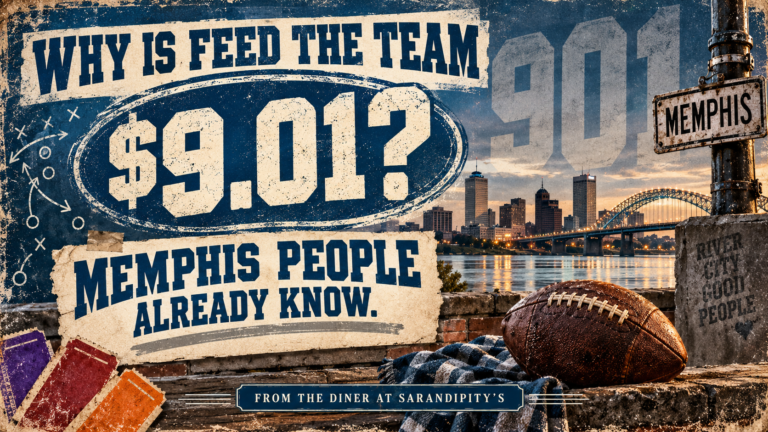
Regularly $14.99, Feed the Team is just $9.01 through September 28, 2026.
And yes, Memphis people.
901 was absolutely intentional.
Or start with a freebie – Don’t Forget the Damn…Game Day Checklist (password FreebieVault)
Don’t Overthink the Head Count
You aren’t catering a state dinner.
You are feeding people who came over to watch football.
Estimate generously. Choose foods that stretch. Keep an easy backup on hand. And remember that running out of one side dish in the fourth quarter does not constitute a hosting emergency.
If everybody ate, everybody had fun, and nobody had to order emergency pizza?
That’s a win.