Starting a kitchen from scratch sounds fun right up until you start making the list.
Pots. Pans. Knives. Mixing bowls. Measuring cups. Appliances. Utensils. Bakeware. Food storage.
And suddenly you’ve got $800 worth of stuff in your cart and you’re seriously considering whether a person actually needs six different spatulas to survive adulthood.
You don’t.
Whether you’re moving into your first apartment, setting up a new house, replacing a kitchen’s worth of worn-out stuff or helping one of your kids stock their first place, you don’t need to buy everything at once.
You need enough equipment to cook the foods you actually eat.
That’s what this list is about.
I’m separating the things I’d consider Day-One kitchen essentials from the things that are worth buying when you actually start doing the job they’re designed for.
Because creating big dreams on a small budget also applies to the kitchen.
Before You Buy Anything, Take Inventory
If you’re moving out on your own for the first time, you may genuinely have nothing.
But if you’re moving, combining households or replacing an existing kitchen, don’t automatically start over.
Check what you already own.
A scratched-up measuring cup with numbers you can’t read anymore? Replace it.
A perfectly functional skillet that isn’t Instagram-worthy?
Keep cooking with it.
This is also the time to think about how you actually cook.
Someone who cooks from scratch every night needs a different kitchen than someone who primarily reheats leftovers and makes sandwiches.
A baker needs different equipment than somebody who grills four nights a week.
And somebody with three feet of counter space should absolutely not take kitchen-equipment advice from somebody with a giant kitchen and a walk-in pantry.
Start with your food, your space and your budget.
Day-One Kitchen Essentials
These are the things I’d want available before trying to cook regular meals in a new kitchen.
1. A Good Skillet
If you’re buying one skillet to start, make it one you’ll use constantly.
A 10- to 12-inch skillet handles eggs, burgers, chicken, vegetables, grilled sandwiches, sauces and dozens of other everyday jobs.
You don’t need an entire 14-piece cookware collection on Day One.
You need a pan.
If you cook often, you’ll eventually appreciate having different materials and sizes. Cast iron, stainless steel and nonstick all have their places.
But one versatile skillet gets you cooking.
2. A Medium or Large Saucepan
You’ll need something for boiling pasta, making rice, heating soup, cooking sauces and all those other jobs that don’t belong in a skillet.
A 2- to 3-quart saucepan with a lid is a useful starting size.
If you cook for a larger family, go bigger.
3. A Large Pot
You don’t necessarily need a giant stockpot immediately, but you need something larger than your everyday saucepan.
Think:
- pasta
- soup
- chili
- potatoes
- corn
- larger batches of food
A pot with a lid is one of those boring purchases you’ll end up using constantly.
4. One Good Chef’s Knife
Please don’t buy a giant knife block because you think that’s what grown-up kitchens are supposed to have.
Start with a good chef’s knife.
It handles an enormous percentage of kitchen cutting jobs.
Add a paring knife for small work and a serrated bread knife if you regularly need one.
You can build from there.
What matters more than owning twelve knives is having a few sharp ones you actually use.
5. A Cutting Board
Actually, I’d eventually want at least two.
Having separate boards available when you’re working with raw meat and ready-to-eat ingredients makes meal prep much easier.
Choose something large enough to work on without your onion launching itself onto the floor every time you chop it.
6. Mixing Bowls
You already know I have a bowl problem.
You don’t need to join me.
A small, medium and large bowl will cover most everyday kitchen jobs.
Better yet, buy a nesting set so the bowls occupy roughly the footprint of the largest one.
Glass, stainless steel and plastic all have advantages. I use different materials for different jobs, but you absolutely do not need all three to stock your first kitchen.
Start with one useful set.
7. Measuring Cups & Spoons
Even if you use a kitchen scale for baking, everyday recipes still regularly call for cups, tablespoons and teaspoons.
At minimum, look for dry measuring cups containing:
1 cup, ½ cup, ⅓ cup and ¼ cup
And measuring spoons containing:
1 tablespoon, 1 teaspoon, ½ teaspoon and ¼ teaspoon
I prefer measurements that are engraved or stamped rather than printed because eventually those pretty painted numbers can disappear and leave you with a drawer full of tiny metal guessing games.
8. A Liquid Measuring Cup
Liquid and dry measuring cups aren’t designed exactly the same way.
For liquids, you want a cup with measurement lines and room above the highest measurement so you can fill it and read the amount without carrying a completely full cup across the kitchen.
I use glass Pyrex measuring cups constantly.
A 2-cup glass measuring cup is a fantastic starting point. Add a 1-cup and 4-cup later if you’ll use them.
9. Basic Cooking Utensils
This is another category where giant sets look like fantastic bargains.
Until you realize you use five pieces and the other seventeen have been living rent-free in your drawer since 2022.
Start with the basics:
- wooden spoon
- silicone spatula
- turner/spatula
- whisk
- tongs
- ladle
- large serving spoon
Then add specialized utensils when you actually need them.
10. Rimmed Baking Sheets
Even if you aren’t a baker, you need these.
Cookies are just the beginning.
Use rimmed baking sheets for roasting vegetables, cooking bacon, baking chicken, reheating foods, sheet-pan dinners, roasting potatoes and approximately a million other things.
I’d rather own a couple of good rimmed baking sheets in useful sizes than a cabinet full of specialty pans.
11. A Rectangular Baking Dish
A glass baking dish can handle casseroles, baked pasta, brownies, roasted foods, desserts and plenty of other jobs.
And if it comes with a lid?
Even better.
Bake it.
Serve it.
Cover the leftovers.
Put them in the refrigerator.
One less container to wash. I’m sold.
12. Colander or Strainer
Unless you’ve developed a secret technique for draining pasta with sheer determination, you’ll want one.
A basic colander handles pasta, washed produce and plenty of everyday kitchen jobs.
If storage is limited, look at collapsible or nesting options.
13. Can Opener
This is the kind of thing nobody remembers until they’re standing in a new kitchen with a can of tomatoes and absolutely no way into it.
Buy the can opener.
14. Food Storage Containers
You don’t need 47 containers on Day One.
Start with a useful assortment of small, medium and larger containers with lids.
Better yet, choose a system where the containers nest or stack neatly.
If your baking dishes have storage lids, you’re already eliminating some of the containers you need.
That’s exactly the kind of multitasking I look for when stocking a kitchen on a budget.
Small Appliances: Buy According To How You Live
This is where I think most kitchen lists get ridiculous.
Not every kitchen needs every appliance.
Microwave
For many households, yes.
If your home already has one installed, obviously don’t buy another.
Toaster or Toaster Oven
Buy one if you eat toast, bagels, frozen foods or other things you’ll actually use it for.
A toaster oven can perform more jobs but takes up more space.
Coffee Maker
Coffee drinker?
Essential.
Not a coffee drinker?
Congratulations on the counter space the rest of us have sacrificed.
Blender
Useful for smoothies, sauces, soups and certain food-prep jobs.
Not necessarily a Day-One purchase if none of those things are part of your normal routine.
Slow Cooker
I use slow cookers enough that they’d rank pretty high in my kitchen.
But that’s because they match the way I cook.
If you’ve never once thought, I wish dinner could cook itself for eight hours while I ignore it, you don’t need one just because a kitchen checklist says you do.
Air Fryer
Same rule.
Love air-fryer cooking?
Great purchase.
Don’t?
Your kitchen will survive without one.
If You Bake, Add These Next
If baking is something you already know you’ll do, I’d add:
- digital kitchen scale
- loaf pan
- muffin pan
- cooling racks
- parchment paper
- oven thermometer
- hand mixer
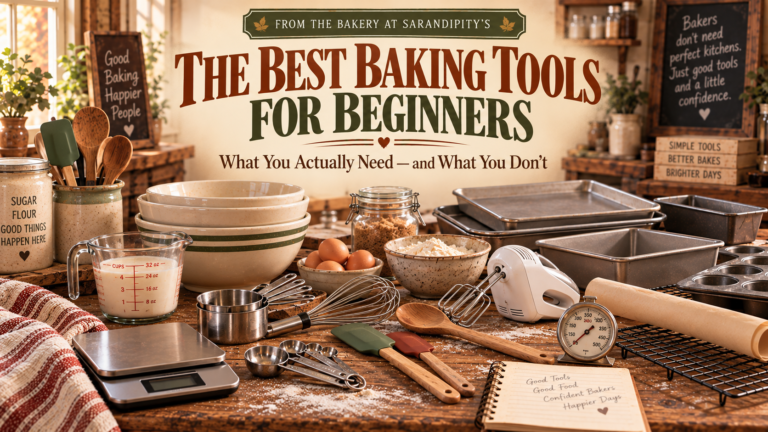
You can see my full breakdown—including where I’d save, where I’d spend and which equipment beginners can skip—in The Best Baking Tools for Beginners.
And if you’re brand new to baking, head over to Baking 101: The Ingredients, Tools, Substitutions & From-Scratch Know-How You Actually Need next. It’ll walk you through the basics without assuming you already know what the heck you’re doing.
What About a Stand Mixer?
Not a Day-One kitchen essential.
There. I said it.
And I own and love a giant KitchenAid.
A hand mixer handles a huge percentage of everyday baking for considerably less money and takes up a fraction of the space.
If you eventually start baking frequently, making bread, working with heavy doughs or producing large batches, then a stand mixer can become a fantastic investment.
Until then?
Keep your counter space.
Starter Sets Can Actually Save Money—Sometimes
I’m normally suspicious when a package contains seventeen kitchen tools and promises to solve every problem you’ve ever had.
But starter sets can make sense when you’re genuinely starting from nothing.
For example, if you need:
a hand mixer + mixing bowls + measuring cups + measuring spoons
and there’s a reasonably priced bundle containing all four?
Compare the bundle price against buying them separately.
The important question isn’t:
How many pieces am I getting?
It’s:
How many of these pieces would I have bought anyway?
Twenty pieces you don’t need aren’t a better deal than six you’ll use every week.
Stocking a Small Kitchen? Make Everything Earn Its Space
When cabinet and counter space are limited, I care almost as much about storage as performance.
Look for:
- nesting mixing bowls
- nesting cookware
- stackable food containers
- baking dishes with lids
- collapsible colanders
- stackable cooling racks
- multi-use pans
- appliances that perform more than one job
Think vertically, too.
Stackable cooling racks are a perfect example. Instead of covering the entire counter with cookies, you’re using the empty air above it.
Counter space is valuable. The air above it is free.
Things You Can Wait To Buy
This is where you can save serious money.
You probably don’t need specialty equipment until you actually start making the thing that requires it.
That includes things like bundt pans, springform pans, specialty cake pans, avocado slicers, egg cookers, dedicated quesadilla makers and whatever other extremely specific gadget the internet has decided will revolutionize your Tuesday.
If you make cheesecake regularly?
Buy the springform pan.
If you’ve never made cheesecake in your life?
It can stay at the store.
The $20 Rule I Like For Kitchen Gadgets
Before buying a cheap specialty gadget, ask:
Can something I already own do this job almost as easily?
If yes, try that first.
Because $8 here, $12 there and $17 somewhere else is how we end up with a $300 drawer full of plastic things we haven’t touched since the week we bought them.
Spend that money where you’ll notice the difference.
Where I’d Spend More
Starting cheap doesn’t always mean buying the cheapest version available.
There are a few places where quality matters more because you’ll use the item constantly.
I’d prioritize money toward:
A good chef’s knife — because a dull, uncomfortable knife makes every prep job miserable.
Cookware you use constantly — especially your everyday skillet and saucepan.
Equipment handling heavy workloads — once you’re actually doing those jobs regularly.
Everything else?
Start practical.
Upgrade when you’ve used something enough to know what you wish were better about it.
That’s when you’re making an informed purchase instead of guessing.
Your First-Kitchen Shopping Plan
If your budget is tight, don’t try to stock the whole kitchen in one afternoon.
Buy First
Cookware, chef’s knife, cutting board, basic utensils, mixing bowls, measuring tools, baking sheet, baking dish, colander, can opener and basic food storage.
Buy Next
Small appliances you know you’ll use, additional cookware sizes, better storage and baking equipment if you bake.
Buy When You Need It
Specialty bakeware, specialty appliances, advanced kitchen tools, expensive mixers and gadgets designed for one specific job.
And yes, sometimes that means cooking for a few weeks before deciding what comes next.
That’s a feature, not a failure.
You’ll discover what your kitchen actually needs.
The Bottom Line
A well-stocked kitchen isn’t the kitchen with the most stuff.
It’s the one where you can make the food you want without constantly discovering you’re missing something important.
Start with versatile basics.
Choose tools that can perform more than one job.
Use nesting and stackable options when space matters.
Keep perfectly functional equipment you already own.
And add specialty tools when your cooking habits—not somebody else’s shopping list—give you a reason to buy them.
You can build a fantastic kitchen a little at a time.
And you’ll probably end up liking it better than the kitchen you’d get by ordering somebody else’s 100-item “must-have” list in one shot.