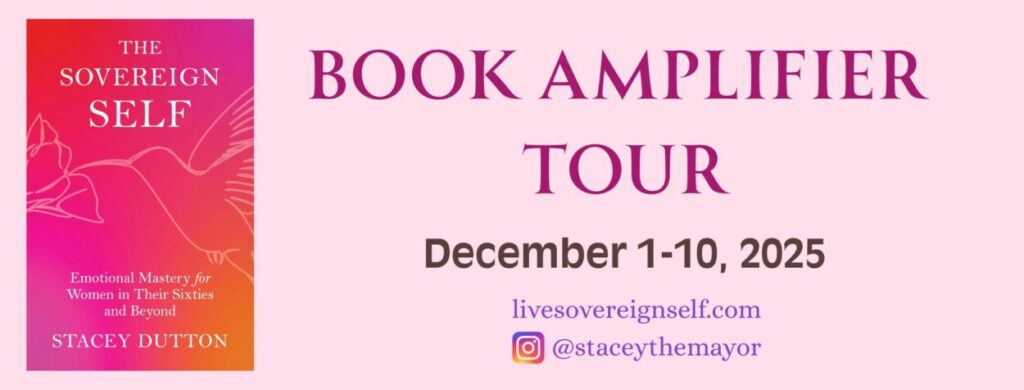
This book event is through Author Marketing Experts.
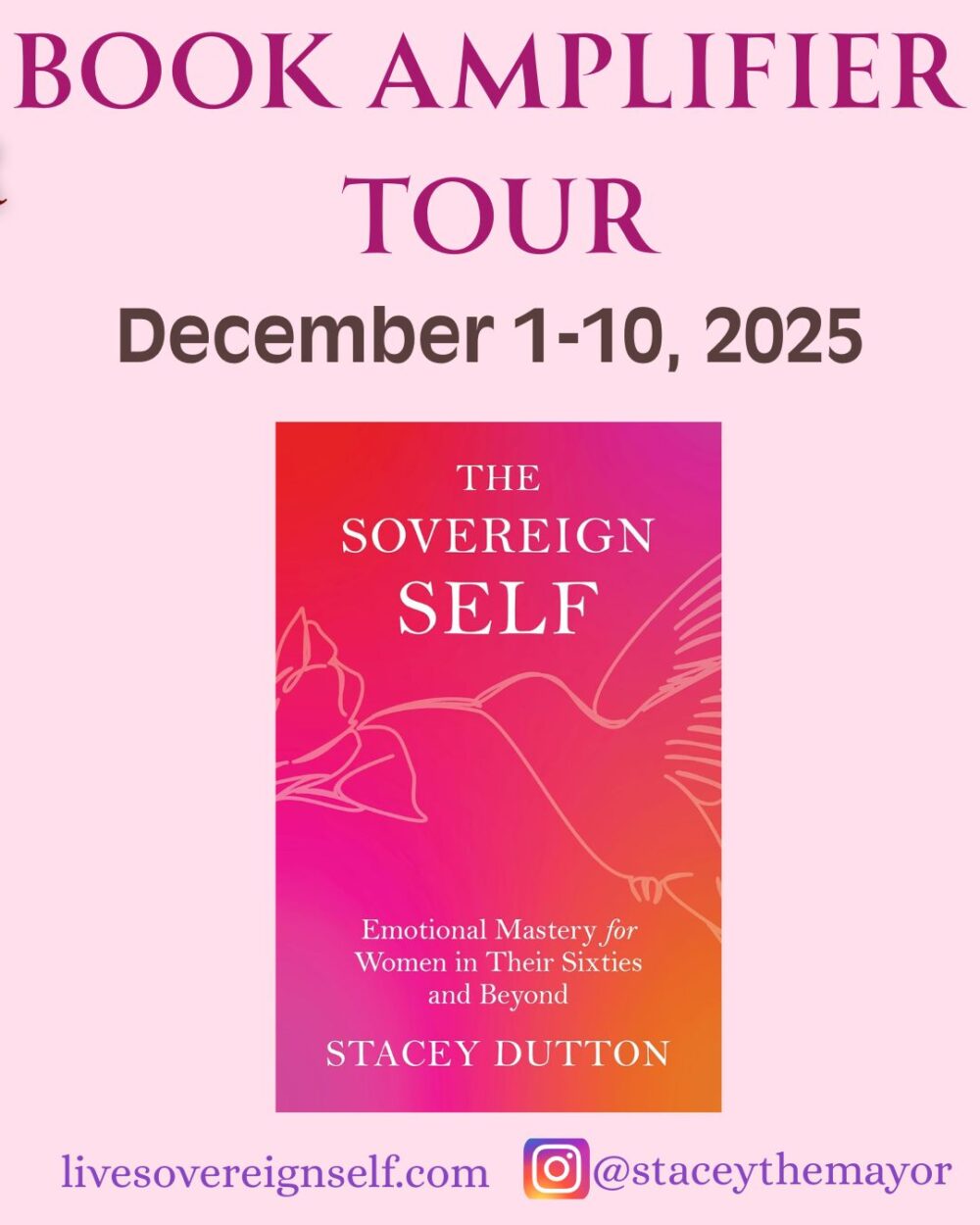
The Sovereign Self book amplifier tour includes an author Q&A, guest blog post, and excerpt below. Check out the other tours on the stop, leave a comment, share, follow, and subscribe. Don’t forget to score today’s Secret Santa freebie with the secret word puzzle and grab today’s $1 deal Christmas Sudoku Puzzle Book with the coupon code, $1DealDay6. Comment in my FB group, tag me on social, respond to my email, or contact me.


Book Details
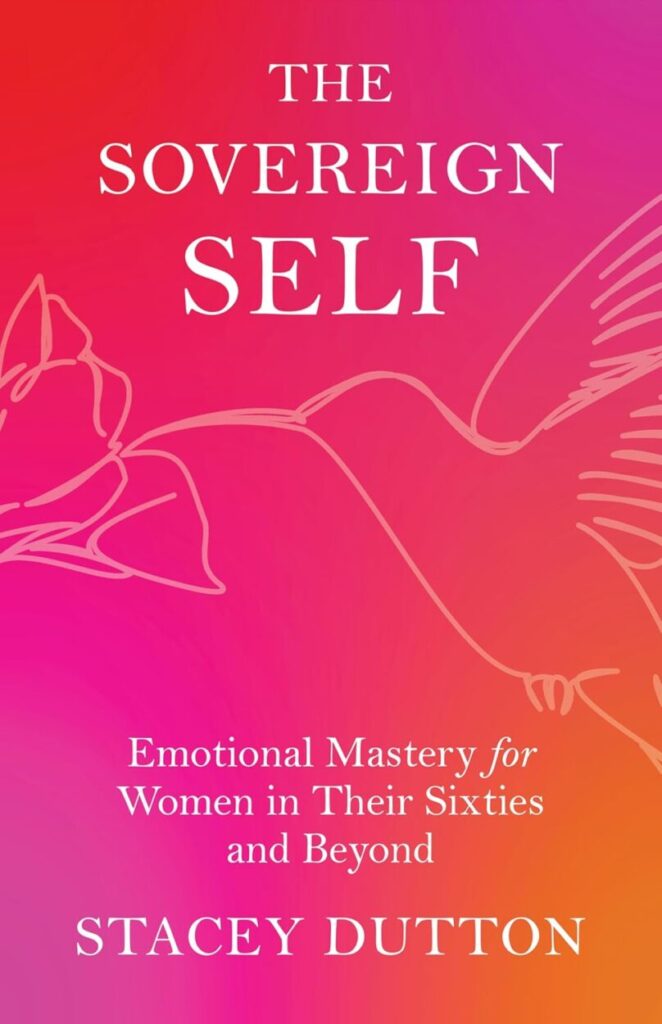
The shift from long-held roles to a more internal definition of self is a theme woven throughout The Sovereign Self by Stacey Dutton. The book focuses on how the sixties prompt questions of identity, emotional presence, and the meaning of living from a more grounded, sovereign center.
In The Sovereign Self, Stacey Dutton examines the emotional landscape of women entering their sixties, a period when lifelong patterns begin to unravel and deeper questions emerge. She explores how emotional mastery—responding instead of reacting, observing instead of absorbing—becomes foundational during this decade. Dutton delves into the evolution of identity, the quiet weight of accumulated emotional labor, the refinement of relationships, and the reclamation of presence. She discusses the body’s shifting terrain, the call toward solitude, the changing meaning of joy, and the relief that comes from releasing old expectations. Throughout the book, she encourages readers to see this chapter not as an ending, but as an awakening into authenticity and self-governance, offering tools and reflections to support a more intentional way of inhabiting the self.
Author Details
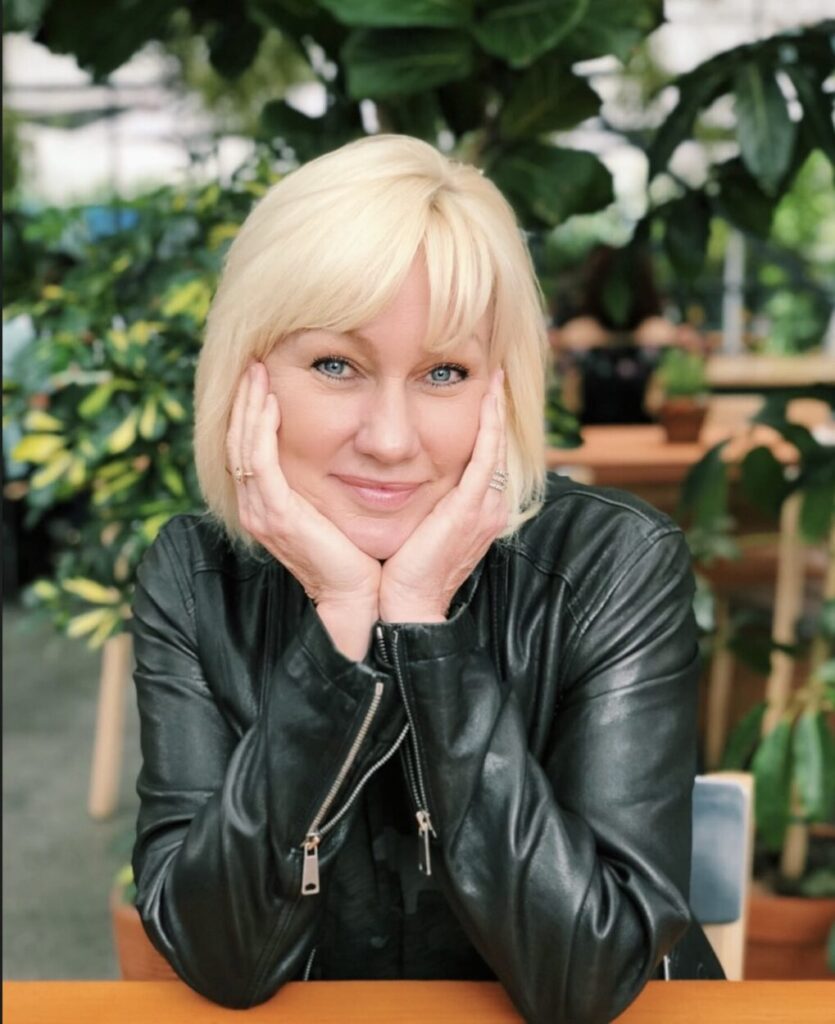
Stacey Dutton is an entertainment executive, creative producer, and emotional mastery advocate with more than three decades of experience across the music, television, and film industries. She was the original on-air host of TLC/Discovery’s Clean Sweep and later the casting director for the Emmy Award–winning Clean House on The Style Network. Through her developing platform, Live Sovereign Self, she guides women in their third act toward clarity, boundaries, and emotional sovereignty. Stacey lives in New Preston, Connecticut, with her husband and their rescue dog. Visit Stacey at her website and on Instagram.
Amazon: https://amzn.to/3KNoSLP
Goodreads: https://www.goodreads.com/book/show/243569125-the-sovereign-self
Excerpt
The Architecture of Emotional Mastery
“You have power over your mind—not outside events.
Realize this, and you will find strength.”
~ MARCUS AURELIUS
For a woman to be emotionally masterful in her sixties is not about mere resilience; it is about refinement. It is not about enduring hardship, but about engaging with life’s complexities with intention, intelligence, and grace.
EMOTIONAL MASTERY AS A DISCIPLINE
By our stage of life, we have encountered loss, reinvention, and profound shifts in identity. We have known both the exhilaration of new beginnings and the ache of things left behind. And yet, despite all we have lived through, true emotional mastery is not something we inherit simply because of experience. Rather, it is something we cultivate with discipline.
The difference between women who struggle through their later years and those who move through them with deep, unshakable presence is not related to their circumstances. It depends on their level of emotional mastery. Those who engage with their emotions deliberately, rather than being ruled by them, typically step into a state of emotional sovereignty—a place where external forces no longer dictate their internal stability.
MASTERY VS. SOVEREIGNTY
Mastery, in its truest sense, is about deep understanding more than control. To master our emotions does not mean suppressing them or forcing ourselves into an artificial state of positivity. It means learning to engage with our emotions as they arise, discerning which of them requires action and which requires release. It means standing in the midst of uncertainty, grief, or change and responding rather than reacting.
Sovereignty is the natural result of emotional mastery. When a woman reaches a place where her emotions no longer control her—a place where she can sit with discomfort without fear or experience joy without guilt—she becomes sovereign over her inner world. She is no longer subject either to the whims of others or to old wounds and the weight of societal expectations. She does not seek permission to feel, to express, or to change. She moves through life with an authority that cannot be given or taken away.
If emotional mastery is the discipline, emotional sovereignty is the reward.
THE MIND AS AN EMOTIONAL ATHLETE
Much like physical strength, emotional mastery requires active engagement. A woman does not wake up one morning emotionally agile, just as she does not develop high muscle tone overnight. Emotional engagement is a practice, like going to Pilates class or lifting weights a few times a week. And yet, many women enter their sixties believing that emotional maturity should be automatic, a natural byproduct of their age.
This is a fallacy. A woman who neglects her emotional strength and agility will find herself bound by old wounds, reactive tendencies, and outdated narratives.
But a woman who deliberately trains her mind—who practices stillness, discernment, and inquiry—will discover a different reality. She will no longer be pulled into every emotional undercurrent. She will not be at the mercy of her past. She will move through her days with a kind of cultivated stillness, unshaken by the temporary and attuned to what truly matters.
This is the foundation of everything that follows in her life.
Guest Post
From Hypervisibility to Invisibility: A Woman’s Lifelong Battle with Being Seen
Women are judged long before we ever understand what judgment is. Our bodies are evaluated, ranked, compared, whispered about, laughed at, or picked apart—often by the very people who claim to love us. And then, as if by some cruel joke, after decades of scrutiny and self-surveillance, we are suddenly told we’re invisible.
Before I was even a teenager, I learned exactly what society thought of me (or at least the people closest to me at that point in my life). I was made fun of for my “big, ugly” feet, my large forehead, my “big” thighs, and my “flat” chest. I absorbed every comment like it was a fact, not an opinion. In high school, a classmate once called me “Frankenstein” because I wore my hair pulled back in a ponytail. Her comment landed with such force that I immediately cut bangs to hide the “bad” forehead she had so generously pointed out.
By my thirties, I was thoroughly trained. When my marriage ended at 37, I celebrated my divorce the way many women do: by trying to “fix” the parts of myself I believed were wrong. My gift to myself was a boob job—because in my mind, getting rid of that “bad flat chest” was the perfect divorce present. Why grieve when you can cosmetically upgrade?
Then came my forties. Purely by accident, I landed an on-air hosting role for a new design show on TLC/Discovery Network. I should have been proud, but instead I received a piece of advice from my best friend at the time—a very famous actress who was no stranger to needles and scalpels: “Buy yourself a top lip,” she told me. Of course. I was about to be on television, so naturally I needed to do something unnatural to my face to look the part. I ended up with a “semi-permanent” lip injection from her facialist—a teeny-tiny bit in both the top and bottom lips, just enough to be “camera ready.” That’s what I told myself.
Then came my fifties—menopause, the grand finale of womanhood. The unexplained weight gain, the emotional upheaval, the shifting body that refuses to obey. That decade was a war with my reflection. I once told my sister before we went out that I needed to put on some makeup. Her response? “Who cares? No one’s looking at us anymore anyway.” It was also during my late fifties that I learned that two of my “friends” were exchanging screenshots of me online, dragging my bangs—because evidently some grown women still behave like “Mean Girl” middle schoolers with nothing better to do.
So that’s the arc: we go from being relentlessly judged—picked apart for every feature, every flaw, every deviation from the ideal—to being told we’re irrelevant. After spending decades trying to be pleasing, presentable, and perfect, we age out of visibility entirely.
Sarah Jessica Parker captured this perfectly when she responded to the barrage of criticism about her gray hair and her lines. She called it what it is: misogynist chatter. She pointed out that the scrutiny she faced would never be aimed at men. She asked what she was supposed to do about aging—stop aging or disappear? She spoke aloud what so many of us feel: that there is a strange, sinister enjoyment society takes in watching women “pained” by their own aging.
This is the impossible landscape women navigate: be beautiful, but not vain; sexy, but not trying too hard; youthful, but not fake; thin, but not obsessed; flawless, but “naturally.”
And when we inevitably fail at achieving the impossible—we vanish.
But here’s the truth: invisibility is not an indictment of our worth. It’s an indictment of the culture that taught us to measure it.
And maybe—just maybe—this stage of life is not about disappearing at all.
Maybe it’s about finally being seen by the only person whose gaze ever mattered: ourselves.
Writing Process & Creativity
How did you research your book?
The research for my book came straight out of self-reflection and my own lived experience—the good, the bad, and the downright ugly. Every phase of my life, from childhood to this newest chapter, has taught me something worth examining. I also read philosophy every day, especially the Stoics, which at this point is like a form of therapy for me.
Where do you get your ideas?
This book was literally born from the journaling I’ve been doing over the past couple of years. I jot down notes after reading passages that hit me in the gut, and I’m constantly writing little reminders to myself about the things I still need to work on (lots of material right there!). So what began as my own personal manifesto—basically a handbook for keeping myself sane—eventually had me thinking, “Why not share it?”
What sets your book apart from others in your genre?
My book isn’t coming from a clinician, a guru, or someone pretending to have all the answers. It comes from someone who has lived through the transitions, reinventions, losses, joys, and identity shifts that women experience in their 50s, 60s, and beyond. Most books for women in midlife lean heavily into reinvention, “you go girl” energy, or vague self-help slogans. In mine, I’m offering a more refined approach: emotional intelligence, discernment, self-reflection, boundaries, and presence, speaking to women who are smart, self-aware, and tired of superficial advice.
Your Writing Life
Do you write every day? What’s your schedule?
I always write at home, usually with my dog on my lap which is challenging at times because his comfort takes priority way over mine. I journal first thing in the morning and then again in the evening; I write something every day, whether it’s pages and pages or just a couple sentences.
Behind the Book
Why did you choose this setting/topic?
I don’t think I chose this topic as much as the topic chose me. As I worked on my own personal growth and journaled about it, I saw this book begin to take shape.
Which author(s) most inspired you?
I’m most inspired by The Stoics. Stoic philosophy originated in ancient Greece and Rome and teaches one essential idea: you can’t control life, but you can absolutely control your response to it. At its core, Stoicism emphasizes emotional steadiness, self-mastery, perspective, and the ability to stay grounded even when life is chaotic. It’s about separating what you can influence from what you can’t and anchoring your peace in that distinction. Most modern therapeutic frameworks, especially Cognitive Behavioral Therapy (CBT) (which is the most widely used form of therapy today) are directly built on Stoic principles.
Fun & Lighthearted Qs
What’s your go-to comfort food?
Junk food: I LOVE potato chips. I’m all about savory foods. I also love sushi – my absolute fave.
What are you binge-watching right now?
The last series I binge watched was The Righteous Gemstones. BRILLIANTLY funny!
If you could time-travel, where would you go?
If I could time travel, I’d go straight ahead a century. I want to know if we’re living like the Jetsons, zipping around in flying cars or if the planet is even still thriving at all??
What 3 books would you bring to a desert island?
The Daily Stoic by Ryan Holiday, The Catcher in The Rye by J.D. Salinger, and The Midnight Library by Matt Haig. Some philosophy, some laughs, and some entertaining fantasy.
What’s something that made you laugh this week? About five minutes ago my 20-pound, VERY reserved and well-behaved dog let out an enormously loud fart. I had no idea dogs could fart so loudly.
Tour Schedule
December 1st
The Faerie Review
https://www.thefaeriereview.com
A Soccer Mom’s Book Blog
https://www.asoccermomsbookblog.com
Girl with Pen
http://victoriazumbrumsreviews.blogspot.com
December 2nd
@onemoreexclamation
http://www.instagram.com/onemoreexclamation
December 3rd
@meghenslittlelibrary
http://www.instagram.com/meghenslittlelibrary
@sudeshnalovesreading
https://www.instagram.com/sudeshnalovesreading
December 4th
PhyllisJonesPisanelliReviews
Long and Short Reviews
http://www.longandshortreviews.com
December 5th
Chapter Break
December 6th
A Wonderful World of Words
https://awonderfulworldofwordsa.blogspot.com
December 7th
The Violet West
http://www.thevioletwest.com/blog
December 8th
StoreyBook Reviews
https://www.storeybookreviews.com
Anytime between 12/1-12/10
Sarandipity’s
Country Mamas With Kids
https://countrymamaswithkids.com