You open the refrigerator.

It’s packed.
Containers everywhere.
Produce drawers are full.
Condiments line the shelves.
Leftovers are stacked in the back.
And yet somehow you’re standing there thinking:
“There’s nothing to eat.”
If you’ve ever experienced this, you’re definitely not alone.
In fact, I think this is one of the most common frustrations families face when it comes to meal planning and grocery shopping.
Because a full refrigerator doesn’t automatically mean you have meals.
And that’s where many households get stuck.

The Difference Between Food And Meals
One of the biggest meal-planning mistakes people make is buying ingredients without buying complete meal solutions.
You have:
- shredded cheese
- half a bag of carrots
- three yogurts
- leftover taco meat
- random vegetables
- four different sauces
Technically, that’s food.
But it isn’t necessarily dinner.
Many refrigerators are full of ingredients that never got connected into a plan.
That’s why opening the fridge can feel overwhelming instead of helpful.
The Grocery Store Trap
Most grocery stores are designed to encourage buying.
Not necessarily planning.
You walk in for milk.
You leave with:
- snacks
- sale items
- produce
- a frozen pizza
- three things that looked good in the moment
Meanwhile, you may still not have enough ingredients for a complete week of meals.
Without a plan, groceries often become collections instead of systems.
And collections rarely solve the dinner problem.
Why Decision Fatigue Makes It Worse
By dinner time, many adults have already made hundreds of decisions.
Work decisions.
Household decisions.
Financial decisions.
Family decisions.
Then comes the nightly question:
“What’s for dinner?”

A refrigerator full of random ingredients creates even more decisions.
A meal plan removes them.
Instead of wondering what to make, you already know.
The Hidden Cost Of Forgotten Food
Every forgotten container represents more than wasted food.
It represents:
- wasted money
- wasted mental energy
- wasted shopping trips
- wasted planning

Most families don’t intentionally waste food.
Life simply gets busy.
Schedules change.
Plans change.
And leftovers quietly disappear into the back of the refrigerator.
Creating a simple meal rotation helps prevent this from happening.
Stop Shopping For Possibilities
This concept changed everything for me.
Instead of shopping for what looked good, I started shopping for specific meals.
Instead of buying ingredients first and figuring out dinner later, I planned dinner first.

Then I bought only what supported that plan.
Suddenly the refrigerator became easier to manage.
Because every item had a purpose.
Create A “Use First” Zone
One of the easiest kitchen systems is creating a dedicated shelf or bin for items that need to be used soon.
This might include:
- leftovers
- produce nearing expiration
- open packages
- partially used ingredients
When everything is visible, it’s much easier to actually use it.

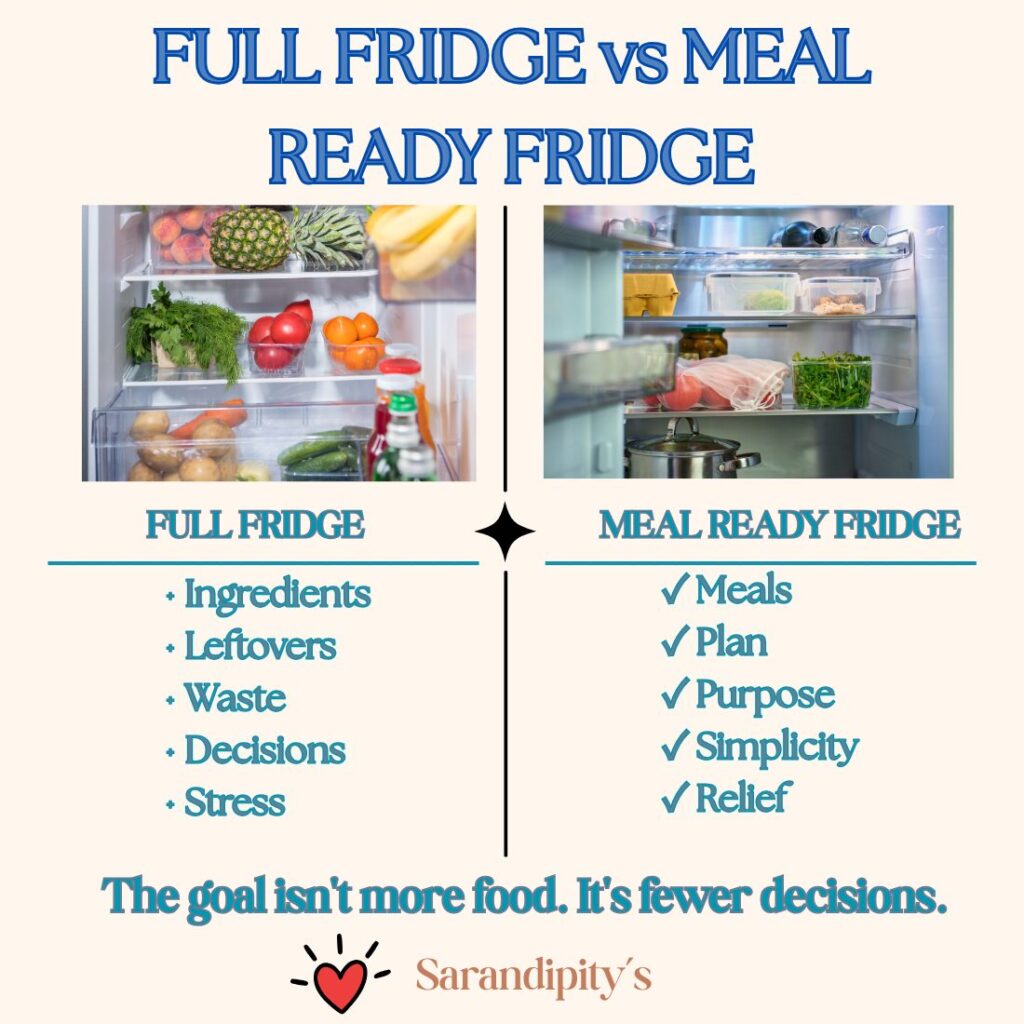
The Goal Isn’t A Full Refrigerator
This may sound strange.
But the goal isn’t a full refrigerator.
The goal is a useful refrigerator.
A refrigerator that supports your meals.
A refrigerator that reduces stress.
A refrigerator that helps answer the question:
“What’s for dinner?”
Instead of creating another problem to solve.
Final Thoughts
If your refrigerator feels packed but dinner still feels impossible, you’re not failing.
You probably don’t have a food problem.
You have a systems problem.
The good news?
Systems are fixable.
A simple meal plan.
A grocery strategy.
A weekly inventory check.
A designated leftovers shelf.
Small changes can completely transform how your refrigerator works for your family.
And honestly, that’s a lot less stressful than standing in front of an open refrigerator wondering where all the food went.