This book promotion is possible through Author Marketing Experts.
Push Back book amplifier tour includes an author Q & A, a guest post, and an excerpt from the book. Share, comment, follow.



Book Details
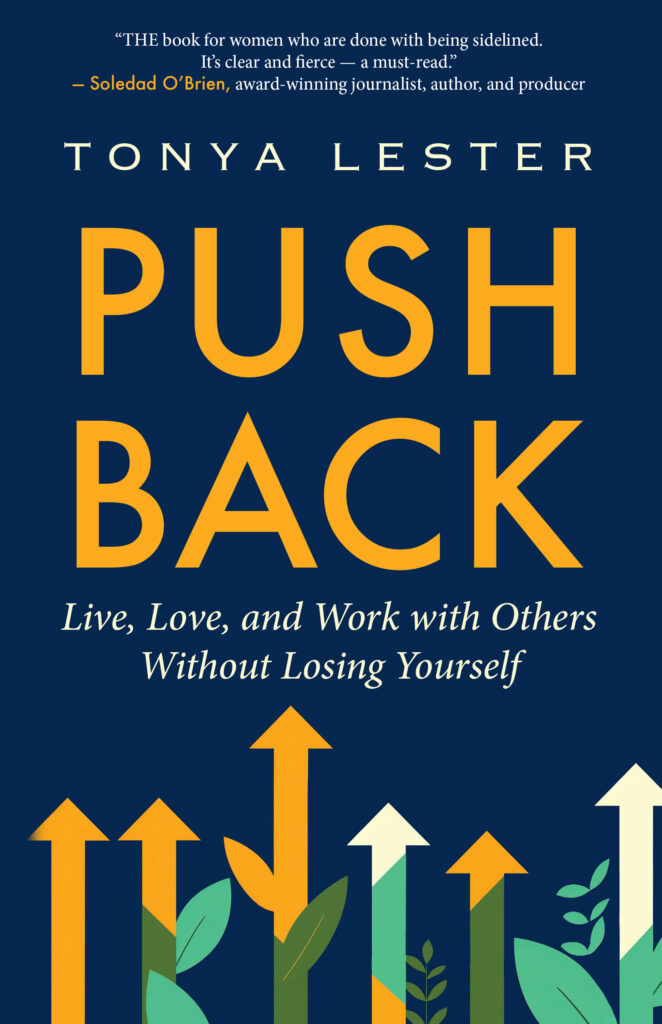
Standing up for yourself can feel uncomfortable — even impossible — when you’ve spent years
prioritizing harmony over honesty. In Push Back: Live, Love, and Work with Others Without
Losing Yourself, therapist Tonya Lester shows readers that assertiveness isn’t the opposite of
kindness; it’s the foundation for genuine connection.
Drawing from her years of work as a psychotherapist and her widely read Psychology Today
blog, Lester examines the cultural, emotional, and systemic reasons women often struggle to
express their needs. From family dynamics to professional environments, she offers a
compassionate look at what happens when we silence ourselves — and how to change it. Push
Back provides readers with a toolkit of language, mindset shifts, and real-life practices to help
them communicate clearly and handle pushback from others with calm and clarity. Lester’s
writing is both psychologically insightful and deeply humane, reminding readers that setting
boundaries isn’t about control — it’s about self-respect.
Excerpt – It’s OK to be Difficult
Years ago, I read a magazine story about an experienced climber who nearly died falling down a
mountain. She’d forgotten the crucial step of double-checking her anchor knots before she started the
climb. It turned out this climber had carefully checked her husband’s rope while neglecting her own. I
imagine this realization flashing through her mind as she tumbled, terrified, down the slope.
As a couples therapist in New York City, I was struck by this article, not as a cautionary tale of
mountaineering safety, but instead as a reminder of the gender dynamics I see normalized in
relationships. Often, women don’t even realize the imperceptible descent they take as they disappear
into relationships, suppressing their own needs and desires while caring for those of others.
Had this climber expected her husband to check her ropes as she had checked his? Had she asked him
to? Or had she trusted herself to tie her own knots correctly but thought that he needed extra looking
after? At what point in their relationship did she start checking his climbing ropes? What were their
interpersonal dynamics in other areas of their lives? Was he like a child, unable to take care of himself?
Or was he considered the talent and she the manager, in charge of ensuring he had everything he needed
to succeed? Whatever else was going on in their marriage, she must not have believed she could take
proper care of herself and also stay in the relationship, because soon after the fall, she filed for divorce.
Women often come to my office to discuss how they might get their husbands to start helping with
childcare. Or to ask how they might better tolerate a bullying boss or backstabbing colleagues.
Sometimes they want to know how to make their thirty-year-old child get a job and move out of the
house. Or how to deal with in-laws who come over unannounced again and again, despite requests to
call first. The list of behaviors these women tolerate goes on and on and could all fall under the umbrella
of other people behaving badly.
While these women want to make changes, they’re worried about coming across as mean, cold, or rude.
They’d like to start speaking up, setting boundaries, and pushing back, but they don’t want to make
anyone angry. They don’t want anyone to think they’re being difficult.
“Why not?” I ask. “What’s so bad about being difficult?”
In Push Back, I want to help you learn that seeking harmony for its own sake is a trap. That there’s no
winning in making everyone else happy at your own expense. And that in nearly every situation, it is
within your power to make positive changes. Truly intractable situations are rare. But to change your
circumstances, you must be willing to push back.
Still, change is hard. There’s going to be resistance from the people around us who like things better
when we’re tending to their needs while neglecting our own. In attempting to break free from these
patterns, we must learn to challenge our thinking and conditioning, behave differently in our
relationships and in our lives, and be prepared to deal with the backlash that will inevitably come when
we push back against the status quo. The cold truth is that the relationships that are most painful for you
are likely working just fine for someone else. As the saying goes, if you want to make an omelet, you
have to break some eggs.
Strong, uncompromising women are both admired and reviled. We’re taught to applaud women who
lean in, speak truth to power, and take no prisoners. “She’s a total badass” is a high compliment.
Slogans like “Breathe Fire” and “Only Weak Men Fear Powerful Women” adorn T-shirts, coffee mugs,
and backpacks. Infants wriggle around in pink onesies that read, “The Future Is Female.” But all too
often, these ideals — speaking up and pushing back when the situation is unfair — fail to make the leap
from merchandise to our daily lives.
In both our personal and our professional relationships, women are encouraged by our culture to be
easy — to minimize our worth and contributions to avoid seeming arrogant, to subordinate our own
needs and desires to preserve goodwill, and to make life as comfortable as possible for the people in our
lives. Instead of learning to speak up, we’re taught to manage others’ behavior. Instead of embracing
healthy conflict, we’re encouraged to avoid conflict at all costs. Instead of leaving unsatisfying
relationships, we’re told to tough it out, give it more time, and try harder.
But continually subordinating one’s own needs comes at a high cost. The necessity to take care of
oneself doesn’t go dormant just because it’s ignored. A 2022 paper from the National Bureau of
Economic Research points out that while women’s rights and autonomy have improved over the past
half century, their self-reported well-being and happiness have declined. Depending on your political
views, this might seem like an indication that conservatives have it right: Women’s work and men’s
work are supposed to be separate, and men’s place is in the economic, political, and intellectual spheres
while women’s place is in the home, family, and community spheres.
But the progress made isn’t the cause of women’s declining happiness. Instead, it’s the lack of societal
support for working parents, inflexible expectations on the parts of employers, spouses who aren’t
carrying their weight at home, and, most insidiously, the myth that women can solve all these problems
with enough elbow grease. As journalist Anne Helen Peterson has described it, “This situation [divorce]
is complicated by the fact that bourgeois [middle to upper class, mainly white] women have been taught
that everything, whether the pay gap or enduring domestic labor discrepancies, can be fixed through
hard work: hard communication work, hard organizational work, hard therapy work. If they just put in
the hours…everything would work out.”
As a result, we twist ourselves into pretzels to make life work for everyone around us. Then we wonder
why we’re burned-out and unhappy.
Does this sound like you? Do you work hard and still feel you aren’t working hard enough? Does it
sometimes feel as if you’re responsible for everyone and everything — your partner’s happiness,
home’s comfort, kids’ success, maybe even the needs of your friends and coworkers, the success of a
group project, or the security of your parents?
I have over two decades of experience working with women who feel stuck, dissatisfied, and frustrated
in their relationships, in their careers, and with their friends and families. In case after case, I’ve found
myself saying things like “What would happen if you told him you didn’t want to?” or “What if you
didn’t respond until the next day?” or “What if you said this situation isn’t working for you anymore and
now you need to make a change?” or even “Just because someone shows up at your door doesn’t mean
you have to let them in your house.” Usually, I’m met with wide eyes, sometimes accompanied by
headshaking or nervous laughter and an unequivocal “I could never say that.”
I know it’s not easy, especially at the beginning. For a long time, this wasn’t how I myself operated. I
struggled to speak up when something was bothering me. I tried to manage the emotions of others
instead of being forthright and honest and trusting other people to manage themselves. I didn’t want
anyone to be upset with me. I worried excessively about making mistakes and settled for easy stagnation
instead of challenging growth. Yet no matter how much I tried to maintain control, I felt increasingly
detached, like my life had gotten off course. Even though I might say to clients that the discomfort of
authenticity in our relationships is better than the discomfort of hiding oneself, tolerating unkind
behavior, or staying when you really want to go, I often settled for the latter.
The possibility of creating conflict with the people I loved and then tolerating their unhappiness or
disapproval seemed excruciating to me, so I didn’t speak up. I didn’t tell the whole truth. And I didn’t
advocate for myself. I didn’t want to appear needy, weak, or demanding. I didn’t want to push back.
Then one morning, I woke up and thought, I am the mountain climber. I am tumbling down the
mountain. I’m not taking care of myself. I felt I couldn’t be in my marriage and still be true to myself. I
thought our patterns were too entrenched, my conflict avoidance and people-pleasing ways too intense,
for me to be in any partnership — not just with my husband — without abandoning myself.
So I changed. I took responsibility for my part in our dynamic, started asserting myself and leaning into
conflict, and insisted on the shifts I needed to see happen in order to feel loved and connected. The
lessons I teach in this book were hard-won. I know how challenging it can be to make changes, but I
also know how rewarding and life altering it is to have done so.
Excerpted from the book Push Back: Live, Love, and Work with Others Without Losing Yourself, by
Tonya Lester. Copyright ©2025 by Tonya Lester. Printed with permission from New World Library
— www.newworldlibrary.com.
Author Details

Tonya Lester is a Brooklyn-based psychotherapist, writer, and speaker whose work focuses on
communication, authenticity, and empowerment. She is the creator of the Psychology Today
blog “Staying Sane Inside Insanity,” which reaches over a million readers worldwide. Her
expertise has been featured in Newsweek, The Guardian, Well + Good, and Bumble’s The
Buzz, and she is a frequent consultant for other mental health professionals. You can find her
online at her website, or follow her on Instagram and TikTok.
Amazon: https://amzn.to/3WLT6RZ
Goodreads: https://www.goodreads.com/book/show/214569834-push-back
Writing Process & Creativity
Where do you get your ideas?
I get my ideas from both my personal life and my work with clients. Push Back was born during a time when nearly everyone around me—my clients, and even my sister, who was going through a divorce—was struggling with the same dynamic: over-accommodating in relationships and losing themselves in the process.
At some point, I realized that while I was coaching women to push back and reclaim their voices, I wasn’t fully practicing that in my own life. That realization became the seed of the book. I wrote it for them—and for me.
What sets your book apart from others in your genre?
A complaint I’ve long had about many self-help books is the assumption that once women start speaking up and setting boundaries, everyone around them will respond positively. That’s simply not true!
Part of pushing back means standing your ground when the inevitable backlash comes.
As I write in the book, the relationships that cause us the most pain are often working just fine for someone else. Push Back doesn’t shy away from that truth—it helps readers prepare for it. What makes the risk worthwhile is the confidence, self-respect, and deeper emotional intimacy that live on the other side of asserting yourself. That’s the promise of Push Back: that the short-term discomfort of standing up for yourself leads to long-term freedom and connection.
What’s your favorite compliment you’ve received as a writer?
I’ve been told I have a clear, warm writing voice, that sounds exactly like how I am in person.
Your Writing Life
Do you write every day? What’s your schedule?
I get up at 6am and write for one hour on weekdays. I don’t write for long, but I am consistent!
Where do you write—home, coffee shop, train?
I write at home on my sofa with my dog, Trouble, and my cat, Luke, tucked in around me.
Any quirky writing rituals or must-have snacks?
Coffee, always and forever.
Fun & Lighthearted Qs
What’s your go-to comfort food?
Potato chips and French onion dip, classic Midwestern snack.
What are you binge-watching right now?
Obsessed with Nobody Wants This and Somebody Somewhere.
Which three books would you bring to a desert island?
The three I’m reading right now: The Loneliness of Sunny and Sonia (Kiran Desai), Heart the Lover (Lily King), and Having It All (Corinne Low)
Tour Schedule
November 10th
The Violet West
https://www.thevioletwest.com/blog
What Is That Book About
http://www.whatisthatbookabout.com
November 11th
Chapter Break
https://chapterbreak.net
A Wonderful World of Words
https://awonderfulworldofwordsa.blogspot.com/
November 12th
@mel_thebookfairy
http://instagram.com/mel_thebookfairy
November 14th
Country Mamas With Kids
https://countrymamaswithkids.com
November 19th
Novel Kicks
http://www.novelkicks.co.uk
Anytime between 11/10-11/19
@aibibyreads
http://instagram.com/aibibyreads
@rebeccareviewedit
https://www.instagram.com/rebeccareviewedit
Sarandipity’s
https://sarandipitys.com
Riley’s Hobbies & Books
https://www.instagram.com/rileyshobbiesandbooks
@sudeshnalovesreading
https://www.instagram.com/sudeshnalovesreading