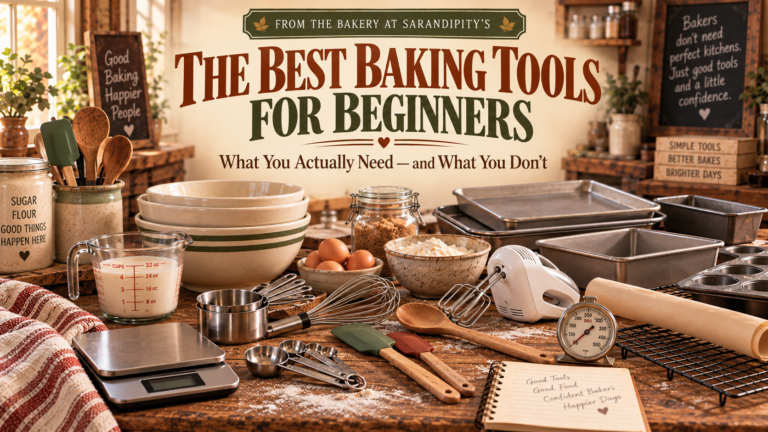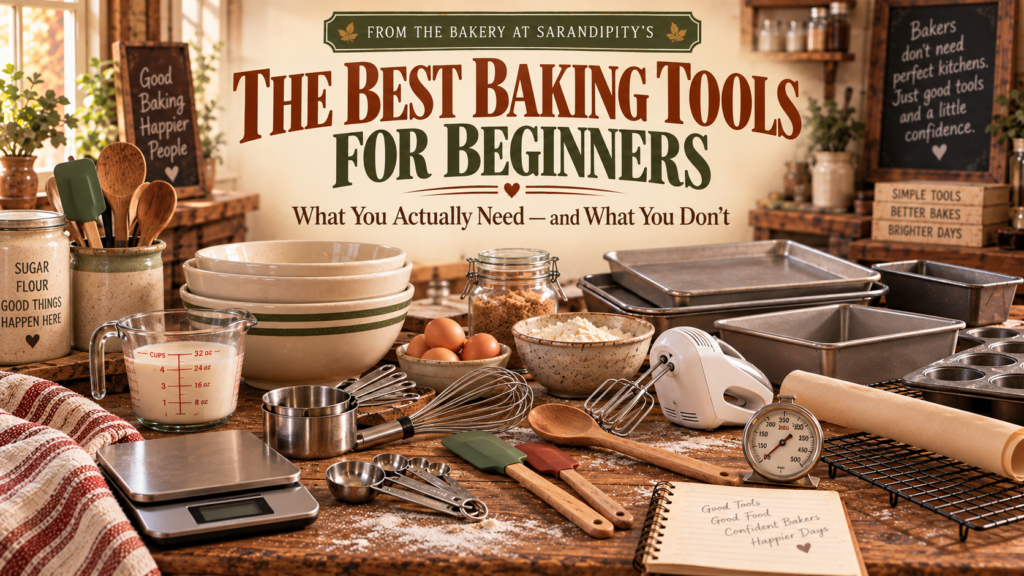
Walk through the baking aisle—or spend five minutes browsing Amazon—and you’d think making chocolate chip cookies requires roughly the same equipment budget as opening a restaurant.
It doesn’t.
If you’re new to baking, you need surprisingly little.
A way to measure ingredients accurately.
A few bowls.
Something to stir with.
A handful of dependable pans.
And eventually, maybe, a mixer.
That’s about it.
I’ve been cooking and baking long enough to learn that more kitchen stuff does not automatically make you a better cook. Half the gadgets marketed as necessities eventually end up shoved behind something you actually use.
So this isn’t a list of every baking tool that exists.
It’s what I’d buy if I were building a baking kitchen from scratch today—including where I’d spend a little more, where I’d save my money and what I’d skip completely until I actually needed it.
If you’re completely new to baking, you may also want to bookmark my Baking 101 guide. It covers ingredients, measuring, substitutions, troubleshooting and the basic know-how that matters considerably more than owning fancy equipment.
Now let’s build your baking kit.
Here’s our rating system:
$ BUDGET PICK
$$ BEST VALUE
$$$ WORTH THE SPLURGE
SARA’S PICK when I personally prefer one
IN MY KITCHEN when I actually own it
1. Digital Kitchen Scale
Worth Buying: Absolutely
If you’re only going to upgrade one thing, I’d seriously consider a digital kitchen scale.
Why?
Because flour is sneaky.
Two people can fill a one-cup measuring cup with noticeably different amounts of flour depending on whether they scoop, spoon, pack or level it.
A scale eliminates most of that variation.
Put the bowl on the scale.
Hit tare.
Add the ingredient.
Done.
It’s more accurate and frequently means fewer measuring cups to wash.
Win-win.
$ BUDGET PICK: Amazon Basics Digital Kitchen Scale
If you’re just starting to weigh your baking ingredients and want to spend as little as possible, this gets you started without a bunch of bells and whistles you probably don’t need.
Best for: New bakers, occasional bakers and tight budgets.
$$ BEST VALUE — Escali Primo Digital Food Scale
This is the sweet spot for most home bakers. The Escali Primo is simple, compact and accurate without charging you extra for a pile of features you don’t need just to weigh flour and sugar.
It measures in 1-gram increments, handles up to 11 pounds and keeps things refreshingly simple with two buttons.
Best for: Most home bakers who want a dependable scale they’ll use regularly.
Do you need the expensive one?
There are much more expensive kitchen scales out there, but most beginner and everyday home bakers simply don’t need one.
Unless you have a specific reason for needing more advanced features or greater precision, I’d put that extra money toward something else in your kitchen.
SARA’S VERDICT
Spend a little here.
Not necessarily a lot—just enough to get a reliable scale.
And if you already own a perfectly functional digital food scale?
Use it.
You don’t need another one because the internet told you bakers like a different brand.
2. Dry Measuring Cups and Spoons
Worth Buying: Yes
Even if you start weighing flour and sugar, you’re still going to encounter recipes written in cups, tablespoons and teaspoons.
You need:
- 1 cup
- ½ cup
- ⅓ cup
- ¼ cup
And measuring spoons with at least:
- 1 tablespoon
- 1 teaspoon
- ½ teaspoon
- ¼ teaspoon
You can certainly buy larger sets containing extra measurements, and some of those are genuinely convenient.
$ BUDGET PICK — 10-Piece Stainless Steel Measuring Cups & Spoons
You don’t need anything fancy here. This affordable 10-piece set gives you the basic measuring cups and spoons you need for everyday baking without spending much money.
The stainless-steel construction is also exactly what I’d look for in an inexpensive starter set: simple, durable and made to do one job.
Best for: Beginners, occasional bakers and anyone building a kitchen on a tight budget.
$$ BEST VALUE — Spring Chef Stainless Steel Measuring Cups & Spoons
If you’re buying your first set and have a little more room in the budget, I’d choose a larger Spring Chef set with the extra measurements.
Along with the standard sizes, some sets include handy measurements like ⅛ cup, ⅔ cup, ¾ cup and ⅛ teaspoon.
Do you need those extra sizes?
No.
Will you appreciate not measuring ⅓ cup twice every time a recipe asks for ⅔ cup?
Absolutely.
The stainless-steel construction and permanently marked measurements also make this the kind of set you can buy once and keep using.
Best for: Regular home bakers and anyone building a kitchen from scratch who would rather buy one complete set.
DO YOU NEED THE EXPENSIVE ONES?
Not really.
There are beautiful designer measuring sets that cost considerably more, but measuring ½ cup is still measuring ½ cup.
I’d rather put the extra money toward better baking pans, a dependable kitchen scale or another tool where spending more can actually improve your baking experience.
SARA’S VERDICT
Save your money here.
Buy stainless steel, make sure the measurements won’t rub off and choose a set that feels sturdy enough to survive being dropped into a drawer approximately 4,000 times.
Already own a complete set that measures accurately?
Keep it.
Your cookies do not care whether your measuring cups match.
What I’d Buy
I’d choose a sturdy stainless-steel measuring cup and spoon set with the measurements engraved or stamped into the handles.
3. Liquid Measuring Cups
Worth Buying: Yes—and Yes, They’re Different
Your dry measuring cups and liquid measuring cups are not the same tool.
Dry measuring cups are designed to be filled to the top and leveled. Liquid measuring cups leave room above the measurement lines so you can measure and pour liquids without wearing half of them.
We’ll get much deeper into this in my upcoming guide to Liquid vs. Dry Measuring Cups, because this is one of those basic kitchen things nobody explains until you’ve already been doing it wrong for fifteen years.
$ BUDGET PICK — All-in-One Measuring Set
If you’re starting a kitchen completely from scratch, an all-in-one set can make a lot of sense.
This one combines liquid measuring cups, dry measuring cups and measuring spoons, so you’re knocking several beginner baking essentials off your list with one purchase.
It’s also a good example of when plastic makes sense: keeping the initial cost of stocking your kitchen down.
Just remember my warning about those measurement lines. I’ve owned plastic measuring cups whose markings eventually faded after repeated washing, so that’s something I’d keep in mind when deciding between an inexpensive starter set and glass you’ll potentially keep much longer.
Best for: First apartments, new kitchens, college students and anyone who needs several measuring tools for as little money as possible.
Pyrex Glass Measuring Cup Set
If you already have your dry measuring cups and spoons covered, I’d go with Pyrex for your liquid measuring cups.
I own Pyrex glass measuring cups and use them constantly. Unlike some of my plastic versions, which have lost their measurement lines after repeated washing, my glass ones are still going strong.
This set gives you the 1-cup and 2-cup sizes, which will handle most everyday baking jobs without taking up a ton of cabinet space.
They’re also surprisingly affordable, so this isn’t one of those recommendations where I’m telling you to spend three times as much just to get my preferred option.
Best for: Pretty much any home baker who wants a simple, durable set of liquid measuring cups.
IN MY KITCHEN • SARA’S PICK
WANT THE 4-CUP SIZE, TOO?
I also own a 4-cup Pyrex, and while you don’t need one to start baking, I definitely appreciate having it when I’m working with larger quantities.
If you’d rather buy all three sizes from the beginning, there’s a Pyrex set containing 1-cup, 2-cup and 4-cup measuring cups.
CHECK OUT THE 3-PIECE PYREX SET ON AMAZON →
SARA’S VERDICT
I’d buy glass.
Plastic absolutely gets the job done, and an inexpensive all-in-one set makes sense when you’re trying to stock an entire kitchen on a budget.
But if you’re buying liquid measuring cups separately, Pyrex gets my vote. Mine have survived years of regular use while the markings on some of my plastic cups have faded enough to make measuring accurately a pain.
Already own plastic measuring cups with perfectly readable lines?
Keep them.
There’s no reason to replace a tool that’s still doing its job.
4. Mixing Bowls
Worth Buying: Absolutely—and Buy More Than One
You don’t need eleven mixing bowls to start baking.
Although, apparently, I do.
I’m a bit of a bowl connoisseur. I’ve got bowls in just about every size and material—from a 10-piece glass nesting set to a 6-piece plastic collection and a 3-piece stainless-steel set.
The secret to owning this many bowls without sacrificing an entire kitchen cabinet?
They nest.
That means the smaller bowls stack inside the larger ones, so an entire set takes up roughly the same amount of cabinet space as its largest bowl.
And seriously, my colorful plastic bowls?
Impulse buy.
I liked the colors.
Don’t be like me.
Unless, of course, you don’t mind finding a home for another half-dozen bowls that you may or may not actually need. In that case, welcome to the bowl collection.
If you’re starting from scratch, you really only need a nesting set with at least:
- one small bowl
- one medium bowl
- one large bowl
Anything beyond that is convenience—not necessity.
WHICH TYPE SHOULD YOU BUY?
GLASS — MY MOST-USED
GLASS — MY MOST-USED
Best for: Everyday baking, bread and doughs, mixing and general kitchen prep.
My glass bowls get used more than any of my other sets.
I love having a large nesting set because there’s almost always a bowl that’s the right size for whatever I’m doing. Mine goes from a hilariously tiny bowl that holds about a tablespoon all the way up to bowls large enough for bread dough.
But here’s the thing:
You absolutely do not need ten bowls.
If you like having tons of sizes for ingredient prep and baking, a large nesting set gives you that flexibility.
CHECK OUT A 10-PIECE GLASS NESTING SET ON AMAZON →
If you’d rather have fewer bowls with more practical everyday sizes, I also like this 5-piece option. You still get a range from a smaller 0.85-quart bowl to a big 4.65-quart bowl, but every bowl comes with a lid.
That makes them useful beyond mixing—you can cover bread dough while it rises, refrigerate cookie dough, marinate something for dinner or stash leftovers without dirtying another container.
CHECK OUT THE 5-PIECE GLASS SET WITH LIDS ON AMAZON →
Glass is heavier and breakable, and larger sets can cost more than basic plastic or stainless steel.
But it’s also what I reach for most often.
IN MY KITCHEN • SARA’S PICK
PLASTIC — LIGHTWEIGHT AND BUDGET-FRIENDLY
Best for: Quick prep, batters, measuring and everyday lightweight jobs.
Plastic bowls are inexpensive and easy to grab.
Some also have features I genuinely like. I have one set with handles and pour spouts and another with measurement markings and lids.
Those measurement markings are especially handy when I can measure directly in the bowl instead of dirtying another measuring cup.
I don’t usually choose plastic for bread dough or heavier mixing jobs, but mine still get plenty of use.
$ BUDGET-FRIENDLY • IN MY KITCHEN
CHECK PLASTIC MIXING BOWL SETS ON AMAZON →
STAINLESS STEEL — LIGHT BUT TOUGH
Best for: Doughs, heavier mixing and anyone who wants something durable without the weight of glass.
My three-piece stainless-steel set has nonslip bottoms and lids, and both features are worth looking for.
The nonslip base helps keep the bowl from skating across the counter while you’re mixing, while the lids make it easy to cover dough, batter or leftovers without transferring everything into another container.
They’re also lighter than my glass bowls while still being sturdy enough that I’m comfortable using them for dough.
$$ BEST VALUE • IN MY KITCHEN
CHECK NONSLIP STAINLESS-STEEL MIXING BOWL SETS ON AMAZON →
WONDERING WHICH MIXING BOWL MATERIAL IS ACTUALLY BEST?
Glass, stainless steel and plastic all have their advantages—and there are some baking jobs where the bowl you choose actually matters.
I’m breaking down the different materials, designs, sizes and best uses in my Mixing Bowl Mania guide.
→ READ MIXING BOWL MANIA
SARA’S VERDICT
Buy a nesting set based on how you actually cook.
You don’t need every material I own. You definitely don’t need to impulse-buy six bowls because they’re pretty colors.
Start with a versatile set containing several useful sizes.
And make sure they nest.
Because cabinet space is valuable, and there is absolutely no reason ten bowls need to occupy the space of ten bowls.
5. A Good Whisk
Worth Buying: Yes
A basic balloon whisk handles a ridiculous number of baking jobs for such a simple tool.
You’ll use it for beating eggs, combining dry ingredients, mixing sauces, smoothing lighter batters and whipping ingredients together when pulling out an electric mixer would be overkill.
MY PICK — Amazon Basics 3-Piece Stainless Steel Wire Whisk Set
You could buy one whisk.
But when a set of three different sizes doesn’t cost much more, I’d rather have the options.
This set gives you 9-inch, 10-inch and 11.5-inch balloon whisks, so you can grab the smaller one when you’re working in a smaller bowl and the larger one when you’ve got more room—or more ingredients—to work with.
The wires are stainless steel, the handles are designed for a comfortable grip, and they’re dishwasher-safe.
Best for: Beginner bakers who want a few useful sizes without spending much money.
$ BUDGET-FRIENDLY
DO YOU NEED AN EXPENSIVE WHISK?
Nope.
There are specialty whisks and premium versions worth considering for particular jobs, but you don’t need them to start baking.
Get a basic balloon whisk—or an inexpensive set like this one—and put the extra money toward equipment where the upgrade actually matters.
SARA’S VERDICT
Save your money here.
A whisk is one of those gloriously uncomplicated kitchen tools.
You want sturdy wires, a comfortable handle and a size that works with the bowl in front of you.
That’s about it.
And for roughly the cost of one whisk, I’d happily take three sizes instead.
6. Silicone Spatulas
Worth Buying: Absolutely
If you’re baking, you need at least one good silicone spatula.
You’ll use it to scrape batter from bowls, fold ingredients together, stir mixtures and rescue that last bit of frosting that is absolutely not being sacrificed to the side of the bowl.
And while one will technically do the job, having a few different shapes and sizes is surprisingly useful.
$ BUDGET PICK — Silicone Spatula Set
You don’t need to spend much here.
A basic set gives you multiple sizes for different jobs, which is much more useful for a beginner than spending the same amount—or more—on one fancy spatula.
Best for: Beginners, tight budgets and anyone who wants several useful spatulas without spending much.
$$ BEST VALUE — OXO Good Grips 3-Piece Silicone Spatula Set
If you want to spend a little more for a set you’ll reach for constantly, I like this three-piece OXO option.
Instead of giving you three versions of essentially the same thing, the set includes a small spatula, everyday spatula and spoon spatula. The different shapes cover scraping smaller bowls and jars, everyday stirring and folding, and scooping wetter batters and mixtures.
They’re also dishwasher-safe, with flexible silicone edges and comfortable nonslip handles.
Best for: Regular home bakers who want a small, versatile set rather than a drawer full of nearly identical spatulas.
DO YOU NEED EXPENSIVE SPATULAS?
No.
This is another category where I’d rather see you buy a few useful shapes and sizes than spend a pile of money on one.
Look for silicone that’s flexible enough to scrape the curve of a bowl but sturdy enough that it doesn’t flop around uselessly when you’re working with thicker batter.
SARA’S VERDICT
Buy a set.
One spatula works until it’s covered in chocolate batter and suddenly you need another one.
You don’t need twelve.
But two or three different sizes and shapes?
You’ll use them.
7. Wooden Spoon
Worth Buying: Yes
A wooden spoon is about as basic as kitchen equipment gets—and that’s exactly why it’s so useful.
You can stir thick batters, mix doughs, combine ingredients and use it for everyday cooking without worrying about scratching your cookware. Wood also doesn’t conduct heat like metal, so the handle isn’t going to get blazing hot just because you left it sitting in the pot.
You don’t need anything fancy here.
$ BUDGET PICK — HANSGO 3-Piece Wooden Spoon Set
If you just need wooden spoons, this is where I’d start.
You get three 12-inch wooden spoons, which is plenty for basic baking and everyday cooking without buying a giant utensil collection you don’t need.
And having three means when one is currently covered in cookie dough, you’ve still got two more.
Best for: Beginners, bakers who just need the basics and anyone who already owns the rest of their cooking utensils.
WANT THE WHOLE WOODEN UTENSIL SET?
If you’re stocking a kitchen from scratch—or you’ve decided you want to replace more than just your spoons—the second option makes more sense.
This 12-piece teak set gives you several different utensil shapes rather than a collection of identical spoons, plus a spoon rest.
That’s overkill if all you need is something to stir brownie batter.
But if you need cooking utensils anyway?
Buying the set may make more sense than collecting them one at a time.
Best for: New kitchens and anyone who wants a more complete wooden cooking-utensil collection.
CHECK OUT THE COMPLETE WOODEN UTENSIL SET ON AMAZON →
SARA’S VERDICT
Keep this one cheap and simple.
If you already own a decent wooden spoon, you’re done. Keep using it.
If you don’t, grab a basic set and move on.
The larger utensil set only makes sense if you’ll actually use the other pieces. More pieces isn’t a better deal if half of them spend the next five years living untouched in a drawer.
8. Rimmed Baking Sheets
Worth Buying: Absolutely
If you’re going to bake, you need baking sheets.
Cookies may be the obvious answer, but you’ll use these for everything from roasting nuts and toasting ingredients to sheet-pan dinners and catching drips underneath something that looks suspiciously determined to bubble over in your oven.
And I strongly recommend rimmed baking sheets.
That little raised edge makes them much more versatile than completely flat cookie sheets—and considerably better at keeping melted butter and other liquids off the bottom of your oven.
SARA’S PICK — Nordic Ware Naturals 3-Piece Baker’s Delight Set
If you’re buying baking sheets from scratch, I really like this set because you aren’t getting three copies of the same pan.
You get:
- a quarter sheet
- a jelly-roll pan
- a half sheet
That gives you a smaller pan when you’re baking a little, a larger one when you’re baking a lot and a useful size right in between.
They’re made from uncoated aluminum with reinforced steel rims designed to help prevent warping, and they’re oven-safe up to 500°F.
Best for: Beginner and regular home bakers who want a few useful baking-sheet sizes without buying them individually.
SARA’S PICK
CHECK PRICE ON AMAZON →
STOCKING AN ENTIRE KITCHEN? CONSIDER A BAKEWARE SET
If baking sheets aren’t the only pans you need, this is where buying a larger bakeware set can make more sense.
Instead of spending your budget buying every pan individually, the Pyrex set gives you several different types of bakeware in one purchase.
That’s especially appealing if you’ve just moved into your first place, you’re replacing a mismatched collection or you’re basically starting with an empty cabinet.
Best for: Anyone stocking a kitchen from scratch who needs several different kinds of bakeware—not just baking sheets.
CHECK OUT THE PYREX BAKEWARE SET ON AMAZON →
SARA’S VERDICT
This is somewhere I’d spend enough to get decent pans.
You don’t need luxury baking sheets, but flimsy pans that twist, warp or bake unevenly aren’t much of a bargain.
I also really like buying different sizes instead of multiples of one size when you’re starting out. You’ll quickly discover that you don’t need a giant half sheet every time you want to bake six cookies.
Start with a few useful sizes.
You can always buy duplicates later when you discover you’re the person who needs to bake four dozen cookies at once.
9. Parchment Paper
Worth Buying: Yes
Technically, you can bake without parchment paper.
Do I want to?
Not particularly.
Parchment helps keep baked goods from sticking, protects your pans and makes cleanup considerably easier.
And while you can absolutely buy parchment on a roll, I’ve become a fan of pre-cut sheets.
No measuring. No cutting. No piece of parchment curling itself back into a tube while you’re trying to convince it to lie flat on the pan.
MY PICK — Pre-Cut Parchment Paper Sheets
This pack comes with 220 pre-cut 12 × 16-inch sheets, so you can pull one out of the box and get on with your baking. They’re unbleached, nonstick and rated for temperatures up to 450°F.
The 12 × 16-inch size is designed for half-sheet pans, but you can always trim or cut a sheet when you’re working with something smaller.
Best for: Anyone who bakes regularly and is tired of fighting with rolls of parchment paper.
$ BUDGET-FRIENDLY
DO YOU NEED PRE-CUT SHEETS?
No.
If you already have a roll of parchment paper sitting in your pantry, use it.
Pre-cut sheets are a convenience purchase, not a baking necessity.
But when it’s time to buy more?
I’m voting for the box of flat sheets.
SARA’S VERDICT
Parchment paper is worth keeping in the kitchen.
You don’t need a fancy brand, and you definitely don’t need to replace a perfectly good roll just because I told you flat sheets are less annoying.
But for your next box?
Pre-cut.
Because apparently one of adulthood’s little luxuries is no longer arguing with a roll of paper.
10. Baking Dishes
Worth Buying: Absolutely
A good rectangular baking dish is one of those kitchen workhorses you’ll use for a whole lot more than baking a cake.
Think brownies, cobblers, cinnamon rolls, casseroles, baked pasta, bread pudding, roasted dishes and approximately 4,000 other things that taste better when they’re bubbly around the edges.
For a beginner, I’d eventually want a couple of different sizes, but you don’t have to buy them all individually.
BEST FOR BAKE, STORE & REHEAT — KOMUEE Glass Baking Dish Set with Lids
If you’re a fan of kitchen tools that can do more than one job, this set makes a lot of sense.
It includes four rectangular glass baking dishes in different sizes plus four matching lids. The dishes nest together without their lids, so you’re getting several sizes without sacrificing half a cabinet to store them.
The lids are the feature I really like here.
Bake dinner, serve it, pop the lid on the leftovers and put the same dish in the refrigerator.
One less container to wash. I’m sold.
Best for: Meal prep, leftovers, smaller households and anyone who likes bake-and-store versatility.
BEST FOR EVERYDAY BAKING — Pyrex Rectangular Bakeware Set
If you want straightforward, dependable baking dishes without a bunch of extras, Pyrex is hard to overcomplicate.
Glass baking dishes are useful for both sweet and savory recipes, and Pyrex glass can go from baking to serving to storing without absorbing food odors or stains. Current Pyrex glass bakeware is also designed for the freezer, microwave, dishwasher and preheated oven.
This is the kind of basic bakeware that earns its cabinet space because you’ll find yourself using it for far more than casseroles.
Best for: Everyday home baking and cooking.
WANT SOMETHING PRETTY ENOUGH FOR THE TABLE? — HANLANXUE Ceramic Baking Dish Set
Sometimes you want the dish that does the job.
And sometimes you want the dish that does the job and looks good enough to plop directly onto the dinner table.
That’s where I’d consider ceramic.
A nesting ceramic set gives you multiple sizes for baking and serving while adding a little more personality than clear glass.
Best for: Baking, entertaining, holiday meals and anyone who wants bakeware that doubles as servingware.
GLASS OR CERAMIC?
Both can earn a place in your kitchen, and we’re going to need another spin-off here because the material you bake in can affect how your food bakes.
For a beginner, though, don’t make this complicated.
If you want practical, versatile everyday dishes, I’d start with glass.
If you also care about taking a beautiful dish straight from the oven to the table, ceramic is worth considering.
SARA’S VERDICT
You don’t need a cabinet full of casserole dishes.
Start with a couple of useful sizes—or buy a nesting set that gives you several at once.
And don’t fall into the trap of thinking these are only for casseroles.
If a baking dish can make dinner on Tuesday, brownies on Friday and apple cobbler on Sunday, it’s earning its keep.
11. Loaf Pans
Worth Buying: Yes
Despite the name, loaf pans aren’t just for bread.
Mine get pulled out for quick breads, sandwich bread, pound cakes and—very frequently in my house—meatloaf.
For most beginners, I’d actually recommend having two loaf pans rather than one. A lot of bread and quick-bread recipes either make two loaves or can easily be divided between two pans.
And if you’re going to make the mess anyway, having a second loaf to eat later, freeze or give away isn’t exactly a hardship.
$ BUDGET PICK — Amazon Basics 2-Piece Nonstick Loaf Pan Set
If you just need a couple of basic loaf pans, you can keep this purchase cheap.
This set gives you two rectangular nonstick steel pans that can handle bread, pound cake, meatloaf and the other everyday jobs you’d expect from a loaf pan.
I use basic metal loaf pans like these all the time for meatloaf, so don’t think they’ll sit around waiting for the next time you decide to bake bread.
Best for: Beginners, budget kitchens and anyone who wants two basic multipurpose loaf pans.
MY BREAD PICK — HOTEC Loaf Pan Set with Silicone Liners
These are the ones I personally love for bread.
You get two loaf pans plus reusable silicone liners, which make both releasing the finished loaves and cleaning up afterward considerably easier.
And I like having two.
Unless you’re intentionally making one long or oversized loaf, plenty of bread recipes can be divided between two standard loaf pans. That means I can bake both at once instead of making one loaf and waiting around to reuse the pan.
Best for: Anyone planning to bake homemade bread regularly.
IN MY KITCHEN • SARA’S PICK FOR BREAD
WANT GLASS? — Razab Large Glass Loaf Pan with Lid
If you prefer glass bakeware, there’s no reason your loaf pan has to be metal.
This Razab option is a substantial 1.9-quart glass loaf pan, and it comes with a lid.
That lid is particularly handy when you’ve made something that needs to be stored afterward. Bake it, let it cool appropriately, cover it and you’ve eliminated another round of transferring food into a storage container.
Best for: Glass-bakeware fans and anyone who likes bake-and-store pieces.
LOVE SOURDOUGH? — Mezzalur Cast-Iron Loaf Pan with Lid
Now this is the loaf pan that caught my attention.
I’m a huge fan of cast iron, and this 11 × 5-inch covered loaf pan is designed specifically with bread and sourdough baking in mind.
The big difference here is the lid.
A covered cast-iron baker traps steam released by the dough during the beginning of the bake, giving sourdough the humid environment that helps create that gorgeous crust we’re after. That’s the same basic reason Dutch ovens are so popular for sourdough baking.
But instead of producing a big round boule, this gives you a traditional loaf shape that’s easier to slice for sandwiches and toast. Loaf-pan sourdough can be particularly convenient when you want uniform slices rather than a free-form artisan loaf.
At 11 × 5 inches and 5.8 quarts, this is also considerably more substantial than your basic little loaf pan.
Best for: Sourdough bakers, serious bread bakers and fellow cast-iron lovers who want a covered bread baker in a traditional loaf shape.
WORTH THE SPLURGE
CHECK OUT THE CAST-IRON SOURDOUGH LOAF PAN ON AMAZON →
DO YOU NEED THIS TO MAKE SOURDOUGH?
Absolutely not.
You can make sourdough in ordinary loaf pans, and there are even methods that use a second loaf pan inverted over the first to trap steam.
This is firmly in want rather than need territory.
But if sourdough becomes one of those things you bake constantly—or you’re already a cast-iron person like me—then specialty equipment starts making more sense.
12. Muffin Pan
Worth Buying: Yes
Muffin pans are another one of those baking tools that earn their cabinet space pretty quickly.
Obviously, there are muffins and cupcakes.
But you can also use them for mini cheesecakes, brownie bites, individual baked oatmeal, egg cups and all kinds of perfectly portioned things that have absolutely nothing to do with muffins.
I own both traditional metal and silicone muffin pans, and I use both for different reasons.
$ BUDGET PICK — Amazon Basics 2-Piece Nonstick Muffin Pan Set
If you just want good basic muffin pans, start here.
This set gives you two standard 12-cup pans, so you can bake 24 muffins or cupcakes at once instead of waiting for the first dozen to finish before starting the second. The pans are heavy-weight steel with a nonstick coating.
I personally own these, and they’re exactly what I want from a basic muffin pan: uncomplicated and useful.
Best for: Beginners, regular muffins and cupcakes, bigger batches and anyone looking for an inexpensive traditional muffin-pan set.
IN MY KITCHEN
MOST VERSATILE — Vnray Silicone Muffin Pan Set
This is where things get a little more fun.
I own this set too, and instead of giving you two identical pans, you get a 12-cup standard muffin pan and a 24-cup mini muffin pan.
That means one purchase covers regular muffins and cupcakes plus all the tiny stuff—mini muffins, bite-sized treats, little appetizers and whatever else I decide would obviously be better if I made it miniature.
The silicone also makes releasing baked goods and cleanup easier, while the reinforced metal frames give the flexible silicone more structure.
Best for: Bakers who want both standard and mini muffin sizes without buying two separate sets.
IN MY KITCHEN • SARA’S PICK FOR VERSATILITY
METAL OR SILICONE?
I use both.
If you’re buying your very first muffin pan and mostly plan to make traditional muffins and cupcakes, I’d start with metal.
If you already know you want regular and mini sizes—or you really like the easy-release benefits of silicone—the Vnray set gives you more variety.
And no, you don’t need both sets just because I own both.
We’ve already established that I’m apparently capable of collecting an unreasonable number of bowls. We don’t need to start another intervention over muffin pans.
SARA’S VERDICT
Start with the size you’ll actually use.
For traditional muffins and cupcakes, a standard 12-cup pan is the basic kitchen staple.
If you bake larger batches regularly, having two is incredibly convenient.
And if mini muffins, bite-sized desserts or individual appetizers sound like something you’d actually make, a standard-and-mini combo gives you more options without filling the cabinet with another pile of pans.
Already own a perfectly good muffin pan?
Keep it.
Your blueberry muffins aren’t checking the logo stamped on the bottom.
13. Cooling Racks
Worth Buying: Yes
Could you cool cookies directly on the baking sheet?
Sure.
But a cooling rack lets air circulate underneath your baked goods instead of trapping heat and steam against the bottom. They’re useful for cookies, breads, muffins, cakes and pretty much anything you’d rather cool than accidentally steam.
And if you bake in batches, how much counter space those racks steal starts to matter.
$ BUDGET PICK — Stainless-Steel Cooling Rack Set
For most beginner bakers, a basic set of stainless-steel wire racks is plenty.
You don’t need fancy features. You need sturdy racks with enough room underneath for air to circulate—and preferably more than one so the second batch of cookies isn’t homeless while the first one cools.
Best for: Beginners, occasional bakers and anyone who has plenty of counter space.
$$ BEST VALUE — Hunnycook Stackable Cooling Rack Set
If you regularly bake multiple batches, I’d seriously consider going stackable.
Instead of spreading several cooling racks across the counter, these can be stacked vertically so you’re using the space above your counter instead of all of the space on it.
That’s particularly useful during cookie season, holiday baking or anytime you’ve decided that making one dozen of something would apparently be far too reasonable.
Best for: Batch bakers, cookies, holiday baking and kitchens where counter space matters.
BEST SPACE SAVER — 4-Tier Collapsible Cooling Rack
Now we’re getting into the option for people who bake a lot at once.
This rack gives you four vertical cooling levels, with adjustable tier heights for different baked goods. When you’re finished, the whole thing collapses down for storage.
That’s a huge advantage if you need a lot of cooling space but don’t actually have acres of countertop available.
Do you need a four-tier cooling tower to bake your first batch of chocolate-chip cookies?
Absolutely not.
But if you regularly bake several batches at once, make Christmas cookies by the truckload or simply have a small kitchen, using vertical space instead of horizontal space is pretty damn clever.
Best for: Serious batch bakers, holiday baking and small kitchens that need maximum cooling space with a smaller footprint.
SPACE-SAVING PICK
DO YOU NEED STACKABLE RACKS?
No.
If you bake one pan at a time, basic cooling racks are perfectly fine.
Stackable racks become worth considering when your baking habits start creating a counter-space problem.
And that’s really the point of paying more here: not because your cookies somehow cool better on expensive racks, but because you’re buying more usable cooling space without needing more kitchen.
SARA’S VERDICT
Start basic unless space is already an issue.
A couple of regular cooling racks will handle most beginner baking.
But if you frequently make multiple batches—or you know exactly what it’s like to have every available inch of the kitchen covered in cookies—I’d spend a little more for something stackable.
Counter space is valuable.
The air above it is free.
14. Oven Thermometer
Worth Buying: Yes
Here’s a fun little fact your oven may not want you to know:
The temperature you set isn’t necessarily the temperature inside it.
Ovens cycle on and off as they heat, and some run consistently hotter or cooler than the temperature on the dial. When you’re baking something temperature-sensitive, that difference can matter.
An inexpensive oven thermometer gives you an independent way to see what’s actually happening in there.
$ BUDGET PICK — Taylor Large Dial Oven Thermometer
You don’t need anything complicated for this job.
The Taylor has a large, easy-to-read dial, measures from 100°F to 600°F, and can either hang from an oven rack or stand on it.
And yes—you can use it in gas or electric ovens. You don’t need to buy a special thermometer just because your oven runs on gas. Taylor describes this model as being made for all types of ovens.
Best for: Most home bakers who want an inexpensive way to check their oven’s actual temperature.
HAVE A DOUBLE OVEN? — Get Two
This is one of those situations where buying a two-pack actually makes sense.
If you’re running two ovens, you shouldn’t have to move one thermometer back and forth to figure out what each oven is doing.
Put one in each.
It’s also useful if you want to check different areas of a larger oven for hot and cool spots.
Best for: Double ovens, multiple ovens or anyone checking temperature differences inside a larger oven.
CHECK OUT THE 2-PACK ON AMAZON →
DO GAS OVENS NEED A DIFFERENT THERMOMETER?
No.
You’ll see some oven thermometers advertised specifically “for gas ovens,” but you don’t need a separate gas-specific model for this basic job.
A standard oven thermometer that’s designed to withstand the appropriate temperature range measures the air temperature inside the oven, whether the heat comes from gas or electricity.
So unless another thermometer offers a feature you specifically want, I wouldn’t buy a third one just because the listing says “gas oven.”
SARA’S VERDICT
Spend a few bucks here.
An oven thermometer isn’t exciting.
It doesn’t mix anything, bake anything or make your kitchen prettier.
But when the recipe says 350°F and your oven has apparently decided that 350°F is more of a suggestion, this cheap little tool can help you figure out what’s going on.
And if you have a double oven like I do?
Buy two and leave one in each.
15. Hand Mixer
Worth Buying: Yes
You can absolutely bake without an electric mixer.
Your arm may have opinions about that decision.
A hand mixer makes quick work of creaming butter and sugar, whipping cream and egg whites, mixing cake batter, making frosting and handling plenty of other everyday baking jobs without taking up the counter space of a stand mixer.
And for a beginner?
I’d buy a hand mixer before I’d spend hundreds on a stand mixer.
$ BUDGET PICK — Hamilton Beach 6-Speed Hand Mixer
If you just need a dependable hand mixer without spending much, this Hamilton Beach gives you a surprising amount for the money.
It has six speeds plus QuickBurst, 275 watts of peak power and a snap-on storage case to keep the mixer and attachments together. It also includes multiple attachments, including beaters, dough hooks and a whisk.
That makes it more than capable of handling the everyday mixing jobs most beginner bakers actually need.
Best for: Beginners, occasional bakers and anyone who wants a useful hand mixer without spending much.
STOCKING A KITCHEN FROM SCRATCH? — Hand Mixer + Baking Essentials Set
If you’re starting with an almost-empty kitchen, a bundle can make more sense than buying every tool separately.
This set combines a 5-speed hand mixer with mixing bowls, measuring tools and other basic baking equipment, letting you knock several things off your kitchen-shopping list at once.
Would I buy it if I already owned bowls, measuring cups and the rest?
Probably not.
But for a first apartment, new home, college kitchen or somebody who’s starting with basically nothing?
That’s exactly where a set like this starts making sense.
Best for: New kitchens and anyone who needs the mixer and several of the basic tools that go with it.
CHECK OUT THE KITCHEN-STARTER SET ON AMAZON →
IN MY KITCHEN — KitchenAid 9-Speed Hand Mixer
This is my hand mixer, and I love it.
The KitchenAid gives you nine speeds, which means you have more control between gently incorporating ingredients and going full speed to whip cream or egg whites.
It also comes with more than basic beaters. You get Turbo Beaters, a Pro Whisk, dough hooks and a blending rod, plus a storage bag to keep everything together.
I especially like having a hand mixer even though I also own a KitchenAid stand mixer.
Sometimes I’m making something heavy enough—or enough of it—that I want the stand mixer.
Other times?
Dragging out the big mixer would be ridiculous.
That’s when the hand mixer earns its keep.
Best for: Regular bakers who want more speed control, useful attachments and a hand mixer they’ll reach for constantly.
IN MY KITCHEN • SARA’S PICK
DO YOU NEED NINE SPEEDS?
No.
A basic 5- or 6-speed mixer can handle most everyday baking jobs just fine. More speeds primarily give you finer control, particularly when moving between gentle mixing and whipping. KitchenAid notes that hand mixers commonly range from about three to nine speeds, with additional speeds providing more incremental control.
That’s nice to have.
It isn’t a requirement for making good cookies.
SARA’S VERDICT
Buy a hand mixer before you buy a stand mixer.
For most beginners, it’s cheaper, smaller, easier to store and capable of handling a huge percentage of everyday baking jobs.
If you’re on a tight budget, the Hamilton Beach is plenty.
If you’re stocking an entire kitchen, look at the bundle and calculate whether you’d actually use the included pieces before assuming the set is automatically a better deal.
And if you bake regularly and want something with more control and attachments?
My KitchenAid gets my vote.
A stand mixer can come later—if your baking habits eventually give you a reason to need one.
16. Stand Mixer
Worth Buying: Eventually—Maybe
I’m probably about to commit some kind of baking-blog crime, but here it goes:
You do not need a stand mixer to start baking.
They’re fantastic. I love mine. I use mine regularly.
But they’re also expensive, heavy and take up a substantial chunk of counter space.
If you’re a beginner who mostly makes cookies, cakes, brownies and the occasional loaf of quick bread, buy the hand mixer first.
A stand mixer starts earning its price tag when you’re baking frequently, making larger batches, working with heavy doughs or simply using it enough that you’re tired of holding a mixer in your hand.
$ BUDGET PICK — OLIXIS 10-Speed Tilt-Head Stand Mixer
If you want the convenience of a stand mixer without jumping straight into KitchenAid prices, this is the kind of mixer I’d look at first.
You get a 10-speed tilt-head design that gives you the hands-free mixing advantage most people are looking for when they decide they want a stand mixer.
Best for: Beginners, occasional bakers and anyone who wants a stand mixer without making a major investment.
$$ MODERATE-USE PICK — Martha Stewart 12-Speed Stand Mixer
If you’re going to use your mixer more regularly or want something larger than a basic budget model, I’d move into this middle category before automatically jumping to the most expensive machine.
This Martha Stewart option gives you a larger-capacity tilt-head design and 12 speeds, making it a better fit for someone who bakes regularly but doesn’t necessarily need the heavy-duty machine I use.
Best for: Regular home bakers who want more capacity and versatility without moving all the way into heavy-duty KitchenAid territory.
$$$ SERIOUS BAKER PICK — KitchenAid Artisan 5-Quart Tilt-Head Stand Mixer
If you bake frequently, make bread or want a mixer you’re planning to keep around for years, this is where I’d start looking at KitchenAid.
The Artisan has a 5-quart bowl, 10 speeds and a tilt-head design that gives you easy access to the bowl when you’re adding ingredients or changing accessories.
That tilt-head design is actually one feature I sometimes wish mine had.
My KitchenAid is a larger bowl-lift model, so the head stays stationary while the bowl raises and lowers. It’s incredibly sturdy, but a tilt-head gives you more open access to the bowl when you’re adding ingredients.
For someone who wants KitchenAid quality for regular everyday baking without needing my giant mixer, the Artisan is a really good middle ground.
Best for: Frequent home bakers, regular bread bakers and anyone ready to invest in a long-term mixer.
IN MY KITCHEN — KitchenAid 7-Quart Bowl-Lift Stand Mixer
And then there’s my beast.
I own the KitchenAid 7-Quart Bowl-Lift Stand Mixer from Sam’s Club, and this is the kind of mixer I’d recommend when baking has moved well beyond an occasional hobby.
It’s big.
It’s heavy.
It lives on my counter because I’m certainly not interested in hauling the thing in and out of a cabinet every time I want it.
But I make a lot of bread and work with heavier doughs, and this is where I’ve found KitchenAid really earns its reputation.
The bowl-lift design provides additional stability for dense mixtures and larger batches. KitchenAid specifically recommends its larger bowl-lift machines for frequent bread baking, heavier doughs and longer kneading sessions.
Even better, it has a bunch of attachments for extra versatility, like a meat grinder, cheese shredder, pasta maker, ice cream bowl, and even shaved ice.
Best for: Frequent bakers, serious bread bakers, large families, big batches and anyone regularly asking their mixer to do some heavy lifting.
IN MY KITCHEN • SARA’S HEAVY-DUTY PICK
CHECK OUT MY KITCHENAID AT SAM’S CLUB →
→ COMING SOON: My KitchenAid Attachment Guide — Which Ones I Own, Which Ones I Actually Use & What’s Still on My Wish List
TILT-HEAD OR BOWL-LIFT?
Here’s the simplest way I can put it:
Tilt-head: Easier bowl access, smaller footprint and a great fit for everyday baking.
Bowl-lift: Bigger, heavier and more stable when you’re working with large batches and dense doughs.
KitchenAid’s current tilt-head mixers generally run from 3.5 to 5 quarts, while its bowl-lift models run from 5 to 7 quarts. The company specifically positions bowl-lift machines for larger batches and heavier mixtures.
Neither design is automatically better.
The better one is the one that matches what you actually bake.
SARA’S VERDICT
Don’t buy a KitchenAid because somebody told you every “real baker” needs one.
You don’t.
Start with a hand mixer.
If you eventually find yourself baking frequently enough that you want hands-free mixing, move into a stand mixer that fits your budget and workload.
If you’re regularly making bread, heavy doughs and large batches?
That’s when I’d start seriously considering the KitchenAid investment—and particularly a bowl-lift model.
Mine has proven itself with exactly the kind of heavy-duty baking I bought it to handle.
And if you’re going to spend KitchenAid money, remember that you’re not just buying a mixer.
Baking Tools Beginners DON’T Need Yet
This part may save you more money than everything above.
You probably do not need to start with:
a Bundt pan collection, madeleine pan, tart pans, springform pans, doughnut pans, specialty cookie cutters, electric flour sifter, cake turntable, decorating kit with 86 piping tips, bread proofing basket, pastry wheel or a countertop appliance designed to perform one extremely specific task.
Are some of those useful?
Absolutely.
When you’re making something that requires them.
Buy specialty tools when your actual baking creates a reason to own them.
Not because somebody’s Amazon storefront has a heading that says BAKING MUST-HAVES.
Where I’d Spend More—and Where I’d Save
Here’s my rule.
Spend a little more on:
- Kitchen scale — accuracy matters.
- Baking sheets and pans — construction and material affect baking.
- Mixer — if you’re actually going to use it regularly.
- Knives — not technically a baking-specific purchase, but a good knife is worth owning.
Save on:
- Wooden spoons
- Basic measuring tools
- Simple whisks
- Bench scrapers
- Pastry brushes
- Cookie cutters
- Basic storage containers
The expensive version isn’t automatically better at stirring flour.
My Beginner Baking Kit
If I were starting with an empty kitchen and wanted enough equipment to tackle most basic baking recipes, I’d buy:
Digital scale
Escali Primo
Dry measuring cups and spoons
Stainless-steel nesting set
Liquid measuring cups
Pyrex glass set
Mixing bowls
Three-piece nesting set
Whisk
One balloon whisk
Silicone spatulas
Two or three sizes
Wooden spoon
Baking sheets
Nordic Ware Naturals multi-size set
Parchment paper
8×8 pan
9×13 pan
Cooling rack
Oven thermometer
Hand mixer
KitchenAid 5-Speed
Then I’d add a loaf pan, muffin pan, pie plate, cake pans and other equipment as my recipes required them.
That’s enough equipment to make an enormous amount of food without sacrificing an entire cabinet to things you’ve never used.
What Should You Buy First?
If the budget is really tight, don’t buy this entire list.
Start with what your next recipe requires.
Already have bowls?
Use them.
Your grandmother gave you a perfectly good 9×13 pan?
Use it.
Your $12 hand mixer still works?
For the love of brownies, don’t replace it because I linked a KitchenAid.
The goal isn’t to own my kitchen.
It’s to build your kitchen around the things you actually make.
Want to Learn How to Use All This Stuff?
If you’re new to baking, start here:
Baking 101
My complete beginner guide covers the ingredients, measuring methods, substitutions, equipment basics, troubleshooting and from-scratch know-how that’ll make these tools considerably more useful.
And if you’re looking at this list thinking:
Okay, but what if my kitchen is basically empty?
That’s exactly where we’re going next.
Stocking a Kitchen From Scratch
We’ll build an entire functional kitchen—not just a baking setup—without buying every gadget known to mankind.
Because you need a kitchen that works.
Not a showroom.
From The Bakery at Sarandipity’s
Creating big dreams on a small budget.