Nobody warns you that adulthood is mostly maintenance.
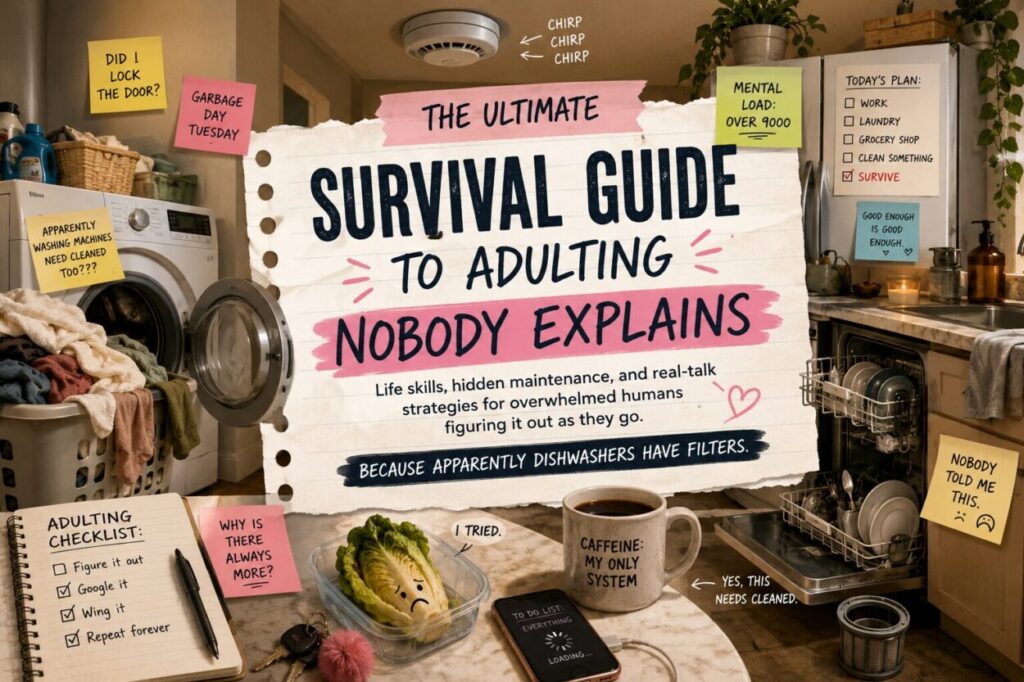
Maintaining:
- your house
- your energy
- your finances
- your laundry
- your emotional stability
- your random collection of chargers
- the vegetables you swore you were going to cook this week
And somehow everyone else acts like they already know the rules.
Meanwhile, you’re standing in your kitchen discovering dishwashers have filters.
Which feels illegal.
Because HOW was that not included in the orientation packet?
That’s the weirdest part of adulthood.
Not the responsibilities.
The hidden mechanics.
The fact that there are apparently 9,000 tiny maintenance tasks quietly operating in the background while everyone pretends this information was obvious the entire time.
You suddenly discover:
- washing machines need cleaned
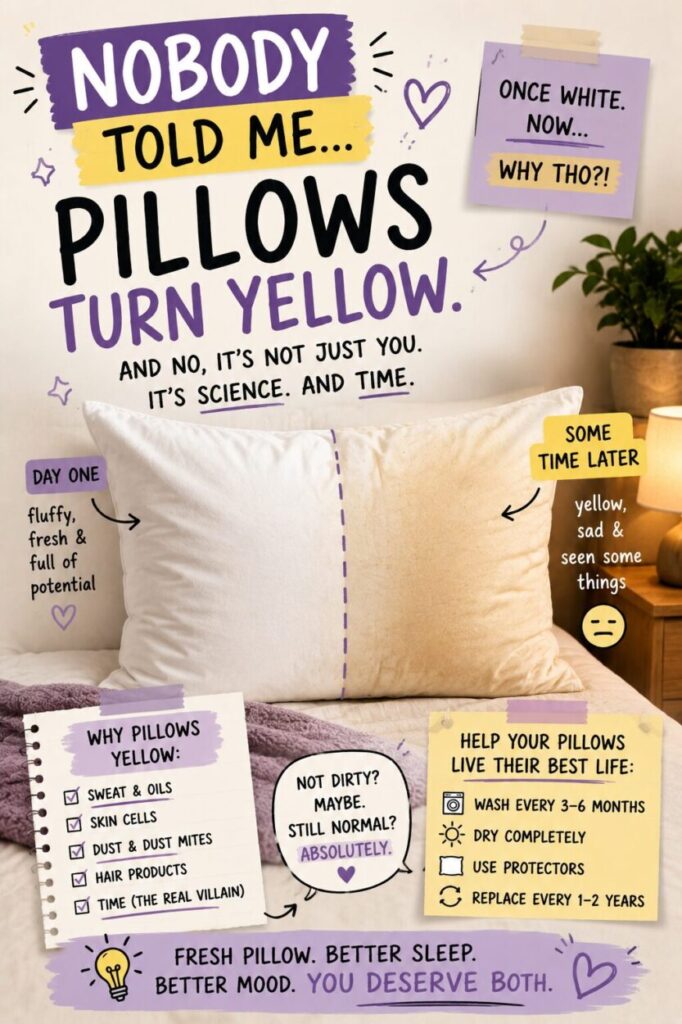
- pillows expire
- towels stop working eventually
- garbage disposals get disgusting
- smoke detectors only chirp at 3 AM
- your fridge can smell bad for reasons science may never fully understand
And somehow all of this becomes YOUR problem.
So if you’ve ever felt behind, overwhelmed, confused, or personally attacked by mildew smell… welcome.
You are not failing adulthood.
You’re just discovering the hidden game mechanics in real time like the rest of us.
This is your survival guide.
Hidden Maintenance Tasks Nobody Explains
One of the most offensive parts of adulthood is realizing that things you thought cleaned themselves… also need cleaned.
Which honestly feels like betrayal.
Dishwashers.
Washing machines.
Ice makers.
Coffee makers.
Dryer vents.
Garbage disposals.
Apparently modern life is just hidden maintenance tasks stacked on top of each other.
And nobody tells you until something smells weird.
Dishwashers Have Filters
This discovery alone has emotionally damaged an entire generation.
At some point, nearly every adult has the moment where they hear:
“Wait… you clean your dishwasher filter, right?”
And your soul leaves your body.
Because no.
No, we did not know that.
We genuinely believed the machine whose sole purpose is cleaning dishes would simply continue cleaning itself forever like some kind of magical kitchen waterfall.
But apparently food particles collect inside the filter.
Which means eventually your dishwasher starts:
- smelling weird
- leaving residue
- not cleaning properly
- creating emotional distrust
Adulting lesson #1:
If it exists, it probably requires maintenance.
Unfortunately.
Washing Machines Need Cleaning Too
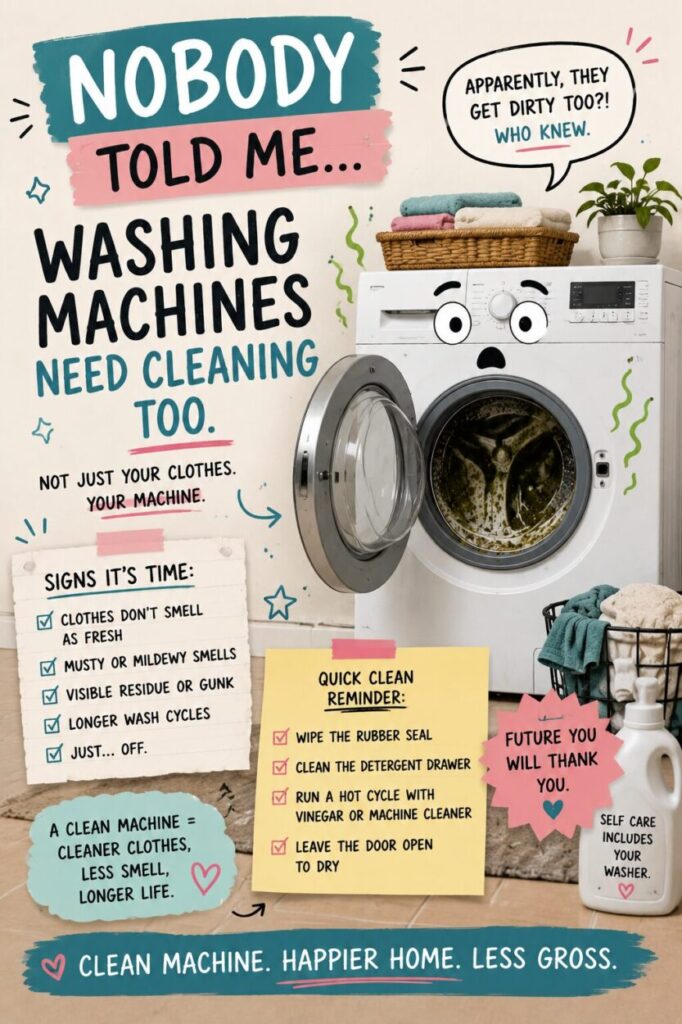
This feels even more fake.
Because again:
THE MACHINE WASHES THINGS.
Why would the washing machine itself need washed?
And yet.
Over time:
- detergent buildup
- mildew
- fabric residue
- trapped moisture
- mystery sludge
all begin forming inside your washer like a tiny haunted swamp ecosystem.
Which explains why towels sometimes emerge from the laundry somehow smelling worse than before.
This is usually the point where adults collectively begin Googling:
“How is my washing machine dirty if it literally washes things?”
The answer is apparently science.
Towels Secretly Expire
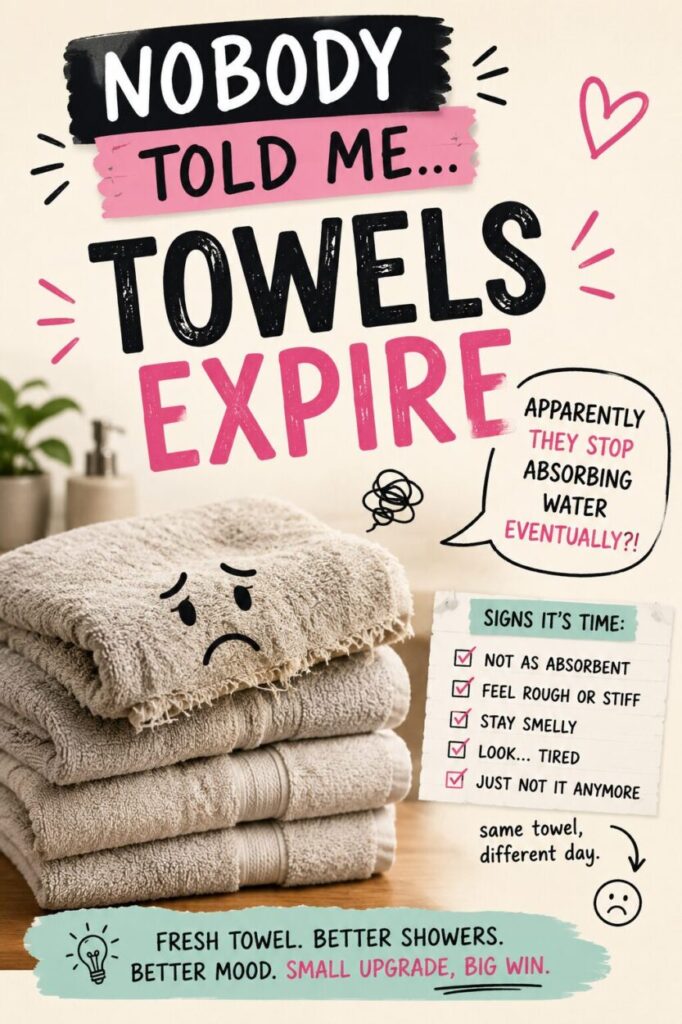
Another devastating adulthood discovery.
At some point you suddenly realize:
your towels don’t absorb water anymore.
Instead they just sort of push moisture around your body while making you feel vaguely insulted.
This happens because:
- detergent buildup accumulates
- fabric softener coats fibers
- repeated washing wears materials down
- mildew starts hanging around uninvited
Nobody prepares you for the day good towels become exciting.
But eventually you understand why adults suddenly talk about:
- towel quality
- vacuum performance
- storage containers
- mattress toppers
- lighting
like they’ve unlocked a new stage of consciousness.
Because comfort becomes survival.
Smoke Detectors Become Your Personal Enemy
Why do smoke detectors ONLY chirp at 3 AM?
Scientists should genuinely study this.
There is no sound more psychologically destructive than the random low-battery chirp that launches you awake from deep sleep while your brain immediately assumes the house is exploding.
And somehow the chirp only happens:
- late at night
- during emotional vulnerability
- while standing on unstable furniture trying to remove batteries you can’t reach
This is adulthood.
Not glamorous success.
Just standing in pajamas angrily negotiating with a ceiling.
Dryer Vents Are Apparently Important
Another hidden side quest.
Most people are not taught:
- how often to clean dryer vents
- why lint buildup matters
- why dryers become inefficient
- that fire hazards are involved
Which means many adults discover this information through panic instead of education.
This is actually the core problem with adulthood.
Most practical life skills are learned reactively.
Not proactively.
Nobody hands you:
- a maintenance guide
- a life operations manual
- a household systems handbook
You just slowly unlock information through chaos.
The Emotional Side of Adulting
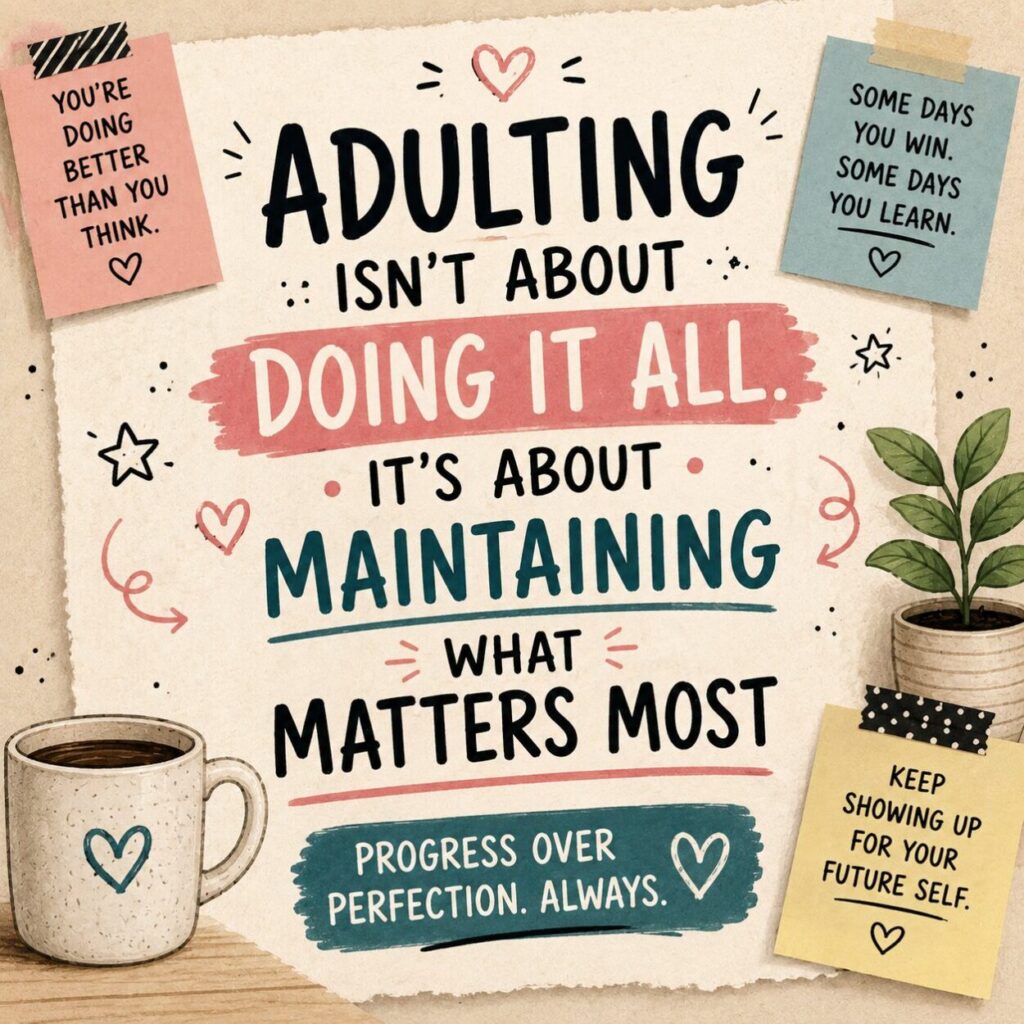
The hardest part of adulthood is not actually the tasks.
It’s the feeling that everyone else somehow understands things you missed.
That emotional feeling quietly follows people everywhere.
You look around and assume:
- everyone else has routines
- everyone else understands finances
- everyone else remembers appointments
- everyone else meal preps consistently
- everyone else cleans baseboards voluntarily
Meanwhile you’re trying to remember whether the laundry has been sitting in the washer long enough to become sentient.
Adulthood creates this strange invisible pressure where people pretend competence even while privately Googling basic survival questions.
Questions like:
- How often should you wash sheets REALLY?
- Why does my fridge smell weird?
- What even IS APR?
- Why do towels stop absorbing water?
- Is everyone pretending to understand insurance?
The answer is yes.
Most adults are improvising.
They’re just improvising quietly.
Feeling Behind Is More Common Than You Think
One of the biggest adulthood misconceptions is the idea that everyone eventually becomes fully organized, fully informed, and permanently emotionally stable.
That person does not exist.
What actually happens is:
- people build systems
- people adapt
- people develop routines
- people learn through mistakes
- people become slightly less chaotic over time
But nobody magically transforms into an all-knowing responsible wizard.
And honestly?
That realization is freeing.
Because it means your confusion is not proof you’re failing.
It’s proof you’re human.
Tiny Mistakes Feel Weirdly Catastrophic
Why does forgetting laundry feel like a personal moral failure?
Why does missing garbage day create emotional collapse?
Why does discovering mold in the bathroom feel like you’ve failed society itself?
Because adulthood quietly ties survival tasks to identity.
Simple mistakes suddenly feel emotionally loaded because they’re attached to:
- responsibility
- competence
- independence
- self-worth
But realistically?
Forgetting laundry is not a character flaw.
It’s just laundry.
And adulthood becomes much easier when you stop turning every small mistake into evidence that you’re bad at life.
Nobody Fully Has It Together
This is maybe the most important adulthood lesson.
The people who appear most organized?
Still forget things.
Still get overwhelmed.
Still panic.
Still eat cereal for dinner sometimes.
Still leave dishes in the sink.
Still ignore emails for concerning lengths of time.
The difference is usually not perfection.
It’s systems.
And systems are learnable.
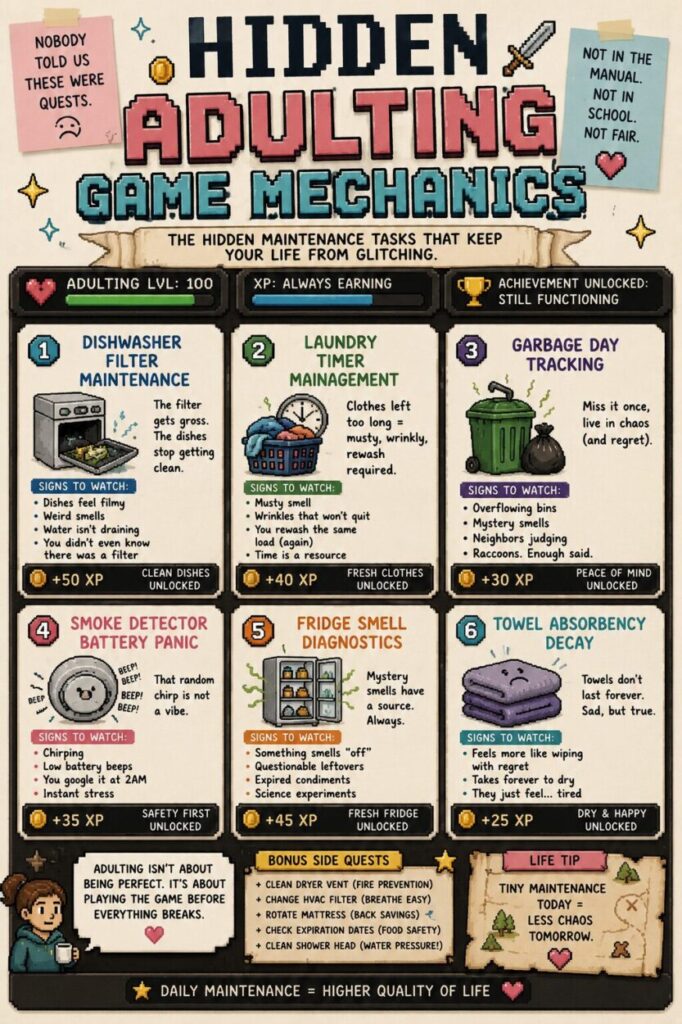
Systems Beat Motivation
This is the secret nobody explains early enough.
Motivation is unreliable.
Systems are what keep adults functioning.
Because eventually you realize:
You cannot build your life around waiting to “feel like” doing things.
Nobody wakes up excited to:
- clean the garbage disposal
- fold laundry
- update insurance information
- clean the shower drain
- organize paperwork
But small systems reduce chaos dramatically.
And honestly?
Most adulthood success comes from reducing friction.
Not becoming superhuman.
The Future You Method
One of the best survival systems is learning to help Future You.
Future You is tired.
Future You is overwhelmed.
Future You deserves backup.
Small actions matter more than dramatic overhauls.
Examples:
- running the dishwasher before bed
- wiping counters quickly
- putting trash bags at the bottom of the can
- setting reminders immediately
- starting laundry early instead of emotionally negotiating with it for 6 hours
Tiny maintenance prevents giant overwhelm spirals.
That’s the real adulthood cheat code.
Maintenance Is Easier Than Recovery
Most people wait until tasks become disasters.
Why?
Because overwhelm creates avoidance.
And avoidance creates larger problems.
Then suddenly:
- the laundry mountain becomes emotionally intimidating
- the dishes become a stress symbol
- the clutter becomes visual anxiety
- the maintenance task becomes a crisis
This is why tiny resets matter.
Not because perfection matters.
Because recovery mode is exhausting.
ADHD-Friendly Systems Matter
A huge number of adults struggle not because they’re lazy.
But because traditional productivity advice assumes people:
- have endless energy
- enjoy routines
- remember things naturally
- thrive under structure
- are emotionally unaffected by clutter
Many people do not function that way.
And that’s okay.
Realistic systems matter more than aesthetic systems.
Examples of functional systems:
- visible storage
- baskets instead of complicated organization
- 10-minute resets
- habit stacking
- “good enough” cleaning
- reducing friction
- creating fewer steps
The goal is functionality.
Not perfection.
Progress Beats Perfection
This applies to almost every part of adulthood.
You do not need:
- a perfectly organized home
- flawless routines
- perfect budgeting
- ideal productivity
- aesthetically pleasing storage containers from the internet
You need systems that support your real life.
That’s it.
A functional life beats a perfect-looking life every single time.
Survival Skills Nobody Teaches in School
School taught us:
- the mitochondria is the powerhouse of the cell
- how to graph equations
- historical timelines
But many adults graduated without learning:
- how credit scores work
- how to grocery shop efficiently
- how to unclog drains
- how often sheets should be washed
- what APR means
- how to maintain appliances
- how to build routines
- how to avoid food waste
Which means adulthood often feels like an escape room with unclear instructions.
Laundry Basics Nobody Explains
Laundry seems simple until suddenly you’re trying to understand:
- fabric care labels
- mildew smell
- shrinking clothes
- detergent amounts
- towel buildup
- dryer settings
Nobody explains that overusing detergent can actually make laundry worse.
Nobody explains that fabric softener can ruin towels.
Nobody explains that leaving wet laundry sitting too long creates the smell of emotional regret.
And somehow everyone just figures this out through suffering.
Grocery Shopping Is a Survival Skill
Nobody warns you how difficult grocery shopping becomes when:
- you’re tired
- overwhelmed
- busy
- mentally exhausted
- trying to budget
- trying not to waste food
Suddenly adulthood becomes:
buying spinach with optimism
and discovering liquified sadness in your fridge 9 days later.
Meal planning sounds simple in theory.
In reality?
Most adults are just trying to survive the week without ordering takeout 11 times.
Budgeting Is Mostly Emotional
This surprises people.
Most financial struggles are not caused by mathematical inability.
They’re caused by:
- stress
- exhaustion
- avoidance
- emotional spending
- overwhelm
- lack of systems
Which is why shame-based financial advice often fails.
People don’t need more judgment.
They need systems that work during real human exhaustion.
Emergency Prep Matters More Than People Think
Most adults do not think about emergency prep until something goes wrong.
Power outages.
Water leaks.
Locked doors.
Dead car batteries.
Then suddenly you realize:
adulting is partially just preparing Future You for chaos.
Even tiny preparation helps:
- flashlight batteries
- extra chargers
- backup toiletries
- emergency savings
- car emergency kits
- basic first aid supplies
Preparedness reduces panic.
And panic reduction is honestly one of the best quality-of-life upgrades available.
The Real Secret About Adulthood
Here’s the thing nobody tells you:
Nobody fully masters adulthood.
People simply:
- adapt
- learn systems
- recover from mistakes
- improve gradually
- become more resilient
That’s it.
Adulthood is not a final level where suddenly everything feels organized forever.
It’s maintenance.
It’s problem solving.
It’s learning hidden mechanics.
It’s discovering that everyone else is Googling things too.
It’s understanding that functionality matters more than perfection.
It’s realizing your worth is not determined by:
- your laundry situation
- your dishes
- your routines
- your clutter
- your productivity level
You are not failing because adulthood feels hard sometimes.
A lot of modern life is genuinely overwhelming.
The good news?
You do not need to become perfect.
You just need systems.
Tiny improvements.
A little maintenance.
A little self-compassion.
And maybe slightly better towels.
Final Thoughts
If adulthood currently feels like a confusing side quest nobody prepared you for… you are deeply, incredibly normal.
Most people are learning through:
- trial and error
- internet searches
- forgotten laundry
- panic cleaning
- random household discoveries
- emotional support coffee
- pure survival instincts
That does not make you bad at life.
It makes you human.
So here’s your official reminder:
You are allowed to:
- learn late
- restart systems
- simplify routines
- do things imperfectly
- ask questions
- create lazy-friendly solutions
- survive before you optimize
Because adulthood is not about having everything together.
It’s about building systems that help you keep going.
One hidden maintenance task at a time.
Related Survival Guides
- Nobody Told Me Dishwashers Have Filters
- The Psychological Damage of Forgotten Laundry
- Nobody Told Me Towels Expire
- Beginner Grocery Shopping Guide
- ADHD-Friendly Cleaning Tricks
- The Future You Cleaning Method
- Why Does My Washer Smell Weird?
- Side Quests for Your Kitchen
- Beginner Budgeting Explained
- Nobody Fully Has It Together
Survival Upgrade Tools
If you’re trying to make adulthood feel slightly less chaotic, explore:
- printable reset checklists
- side quest planners
- adulting survival guides
- home maintenance trackers
- burnout-friendly systems
- beginner life skill tools
Because honestly?
Nobody should have to figure all of this out alone.